
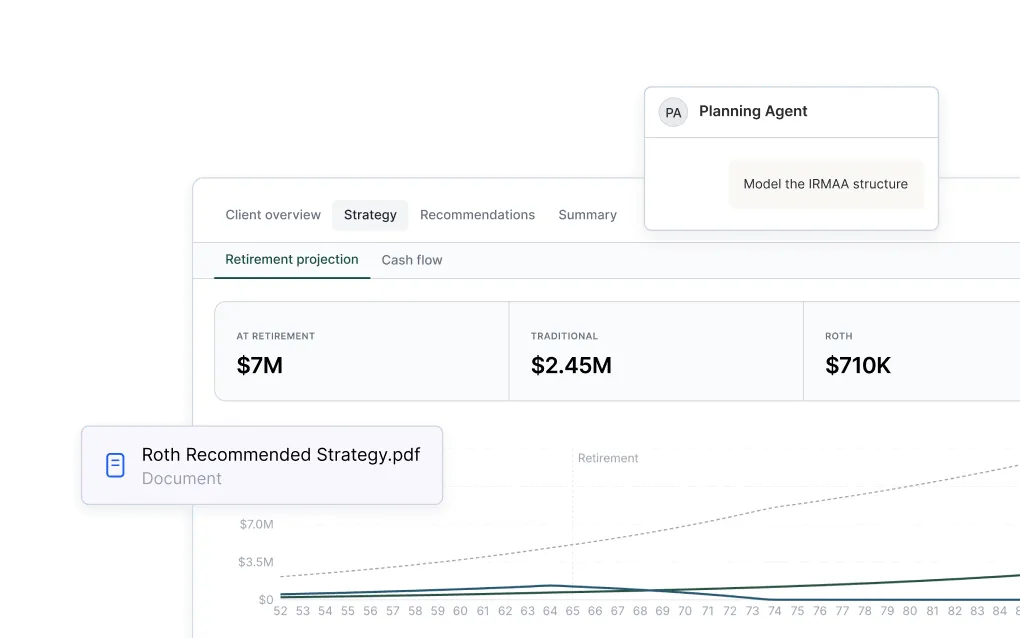

Financial planning & analysis for every moving piece
Your financial life is not a spreadsheet. Our advisors help turn accounts, goals, taxes, risk, and life decisions into a plan you can actually use.

From scattered data to a financial roadmap
Savvy combines advisor insight with modern technology to help you understand where you are, where you are going, and what to do next.
A full view of your financial life
Your advisor can help organize assets, liabilities, income, spending, insurance, taxes, goals, and account connections.
Planning that prioritizes action
The plan translates analysis into practical next steps across savings, investing, taxes, retirement, education, estate, and risk.
Scenario modeling for better tradeoffs
See how choices such as retiring earlier, selling a business, buying a home, gifting, or changing jobs may affect the plan.
How financial planning and analysis works
Savvy helps clients move from uncertainty to a clear set of priorities and decisions.
Organize the data
Your advisor gathers the financial information needed to understand assets, income, expenses, goals, risks, and constraints.
Analyze the tradeoffs
The plan evaluates scenarios, timelines, tax implications, investment assumptions, and competing priorities.
Act, monitor, and adjust
Your advisor helps implement next steps and revisit the plan as life changes.
What you get with a Savvy advisor
Personal guidance with more attention
Savvy handles the operational lift behind the scenes so your advisor can stay focused on your goals, your questions, and the decisions that matter.
70%
More time focused on you
Most financial advisors aren’t legally required to act in your best interest. Savvy Advisors are.
Your advisor is a fiduciary
Many advisors are tied to product incentives, sales targets, or firm priorities. Your advisor is different. As an independent fiduciary, they are required to put your best interest first and give advice shaped around what is genuinely right for you.
Backed by institutional-grade intelligence
Behind your advisor sits an in-house investment team, a direct line to Savvy's Chief Investment Officer, and the best-in-class technology that makes it all run.
18% higher relative return compared to the S&P 500 in 2025*
*Savvy Total Portfolios All Equity vs S&P 500. Relative return refers to the percentage increase between percentages
Planning insights for smarter decisions


.webp)
Make your next financial decision with context
A Savvy advisor can help you build a roadmap that connects today's decisions to tomorrow's goals.
Are you a financial advisor?
Learn how Savvy's platform can help you serve your clients better, with less operational burden and more intelligent tools at your fingertips.
FAQ
Investment management focuses on the portfolio. Financial planning connects the portfolio to cash flow, taxes, retirement, risk, family goals, and life decisions.
Investment management focuses on the portfolio. Financial planning connects the portfolio to cash flow, taxes, retirement, risk, family goals, and life decisions.
Helpful inputs include account statements, income, expenses, debts, insurance, tax returns, estate documents, benefits, equity compensation details, and goals.
Review it at least annually and whenever there is a major life event, market shift, tax change, job change, family change, or new goal.
Yes. Your advisor can consider held-away accounts and outside assets when building a more complete plan.
A good plan is specific, coordinated, realistic, tax-aware, flexible, and connected to the decisions you actually need to make.