



Tax Optimization Strategies for Alternative Investments: UBTI, Carried Interest, and the 2026 Opportunity Zone Deadline

If you hold alternative investments, there are three tax mechanics to pay attention to this year. The first one, UBTI, can generate a tax bill inside an account you thought was tax-sheltered. Private equity, hedge fund, and real estate holdings follow rules that public stocks and bonds do not. This guide covers each mechanic in turn, along with a critical December 31st, 2026 deadline.
Key Takeaways
- UBTI can create a tax bill inside an IRA, and because an IRA is treated as trust, that income may be taxed at compressed trust rates reaching 37% above roughly $16,000.
- An IRA with $1,000 or more of gross UBTI in a year generally must file Form 990-T.
- Carried interest generally requires a holding period of more than three years to receive long-term capital gains treatment under Section 1061.
- Deferred gains sitting in a pre-2027 Qualified Opportunity Fund generally must be recognized by December 31, 2026, even if you keep holding the fund.
- That recognition is a cashless event, so the tax may come due without a distribution to cover it.
Why Alternative Investments Need a Different Tax Playbook
Public stocks and bonds mostly generate 1099s and standard capital gains treatment. Alternative investments generate K-1s instead, and with them, pass-through income, debt-financed income, and compensation structures that carry their own rules.
Related Reading: Learn more about the K-1 form in our guide: What is a Schedule K-1 Tax Form?
The Tax Trap Hiding In Your IRA: UBTI
A tax-advantaged account is not automatically tax-free on every kind of income. Unrelated business taxable income, or UBTI, is the exception most alternative-investment holders meet first, and it can produce a tax bill inside an IRA that otherwise shelters your gains.
What Triggers UBTI
UBTI generally arises in two situations. The first is active trade or business income earned through a partnership your IRA holds. The second is unrelated debt-financed income, or UDFI, which can appear when a fund uses leverage to acquire or improve property.
That second one reaches more investors, since leverage is common in real estate funds and in some private equity structures.
Once an IRA has $1,000 or more of gross UBTI in a year, it generally must file Form 990-T and pay tax on the amount above that threshold.
This doesn’t mean you made a mistake. UBTI is a structural feature of how the underlying investment earns money.
What UBTI Costs You
The rate is more important than most investors expect. An IRA is treated as a trust under Section 408, so its UBTI is generally taxed under the trust brackets rather than at a flat corporate rate.
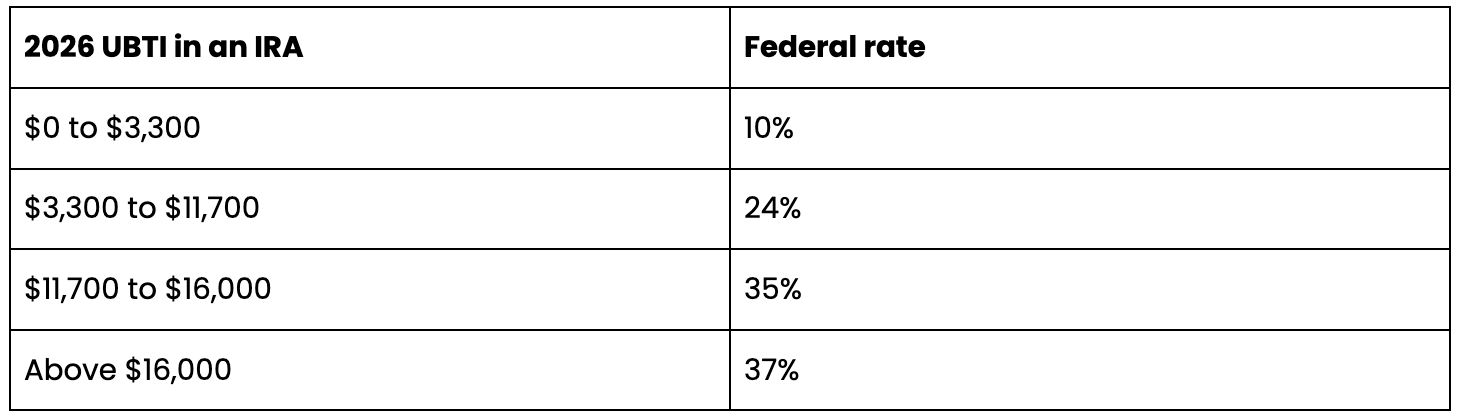
The practical effect: an IRA may reach the top 37% federal rate at roughly $16,000 of UBTI. In contrast, an individual filer generally would not reach that same rate until they earn income well into the six figures. The tax applies inside the account as income accrues, regardless of whether you take a distribution.
Your rate depends on the amount and character of the income, so confirm these figures with your tax professional.
Structuring Around It
The levers here generally sit at the structuring stage, before you commit capital.
Some funds offer feeder structures or blocker corporations designed so that UBTI does not pass through to tax-exempt investors. If that option isn’t available, the alternative is placement: holding the UBTI-generating position in a taxable account instead of an IRA, since a taxable account does not carry the same exposure.
Both choices have to be made before an allocation, not after a K-1 arrives in the spring. This alignment requires your advisor, CPA, and fund sponsor structuring team to review details together prior to investing.
How Carried Interest Is Taxed
Carried interest is important for those in two categories: fund managers who earn it, and limited partners whose net returns are shaped by how it is structured. Most published coverage serves neither, focusing instead on whether the treatment should exist as policy.
The Three-Year Rule
Under Section 1061, added by the 2017 Tax Cuts and Jobs Act and still in effect for 2026, carried interest generally gets long-term capital gains treatment only on gains from assets held more than three years long-term1. Ordinary investment gains reach that treatment after one year.
Miss the three-year mark and the gain is generally recharacterized as short-term, taxed at ordinary income rates topping out at 37% federal rather than the 20% top long-term rate.
A holding period decision can move the same dollar of gain by 17 percentage points.
What This Means for Your After-Tax Return
If you are a limited partner, carried interest is a cost embedded in fund returns before any distribution reaches you. How the general partner’s carry is structured and timed can affect what flows into your own K-1, and when.
Understanding these mechanics allows for accurate interpretation of capital account statements. It does not change your own holding period, which follows separate rules.
Related Reading: See how capital gains tax works for that side in our guide: Understanding Capital Gains Tax: Definition, Rates, and Calculations
The 2026 Opportunity Zone Deadline
This is the most time-sensitive item on the list. It arrives on December 31st, 2026. If you deferred a capital gain into a Qualified Opportunity Fund under the original program, this section applies to you.
What Happens Before December 31
Investors who deferred capital gains into a Qualified Opportunity Fund under the original program generally must recognize the remaining deferred gain by December 31st, 2026. This applies even if you continue holding the fund. The tax code treats it as a deemed inclusion event rather than a sale.
The taxable amount is generally the lesser of two figures: your remaining deferred gain or the fund’s fair market value on that date.
Cash is the part that can throw people off. This is a recognition event without a matching distribution, so the tax may come due without the fund sending you anything to pay it with.
Roughly $75 billion in deferred gains sat inside Qualified Opportunity Funds as of late 2024, across approximately 41,000 investors and 12,800 funds2.
Visual: Simple horizontal timeline: original deferral year → basis step-up milestones (invested by end of 2019 with a 7-year hold, 15% step-up; invested by end of 2021 with a 5-year hold, 10% step-up) → December 31, 2026 inclusion event → January 1, 2027 program restart under OBBBA. This procedural sequence should extract well into AI Overviews.
What Changes in 2027 Under the OBBBA
The program does not end. The One Big Beautiful Bill Act, signed July 4th, 2025, makes Opportunity Zones permanent with rolling 10-year designations beginning January 1st, 2027. Several terms change:
- Rural Qualified Opportunity Funds receive a 30% basis step-up after five years, versus the standard 10%
- The low-income community threshold tightens from 80% to 70% of the area median family income
- The prior contiguous-tract exception goes away3
Your December 31st Action Checklist
There are four steps you can take, and the first two generally require documents that only the fund sponsor can provide.
- Confirm your original deferral amount and investment date from fund documentation.
- Request a current fair market value estimate from the sponsor.
- Model the liability against the lesser of your remaining deferred gain or the fund’s fair market value on that date.
- Plan for the cash, since the recognition event will not fund itself.
Because state rules vary by location, confirm local timing rather than assuming alignment with federal schedules.
Savvy Wealth advisors can help you here, with CPA-prepared returns and your advisor coordinating the documents, elections, and timing as one plan.
Coordinating It All: K-1 Timing and Your Broader Tax Plan
Several of the mechanics above can surface on a K-1. Each is manageable when handled separately, but handled at the same time, in the same portfolio, they compound.
Why K-1s Arrive Late
K-1s frequently arrive close to, or after, the standard filing deadline. Funds have to close their own books before they can report to investors, and that cascade takes time. As a result, many alternative-investment holders file for an extension every year as a matter of routine. An extension here reflects a fund reporting calendar, not a problem with your return.
Bringing It Together
Coordination is the strategy. UBTI exposure, carried interest treatment, and Opportunity Zone deadlines are each solvable on their own. The challenge is when several sit in one portfolio, and nobody is tracking them as a set.
That tracking problem ties into visibility. Alternative-investment positions tend to scatter across custodians, sponsors, and statements arriving on different schedules. A Savvy Advisor can pull those pieces into one picture.
Conclusion
Alternative investments reward patient capital, and they ask for closer tax attention in return. Four steps are worth taking before year-end:
- Identify which alternative holdings sit inside retirement accounts and flag them for UBTI review
- Confirm whether gains tied to carried interest fall inside or outside the three-year window
- Pull fund documentation now if you hold a pre-2027 Opportunity Zone investment
- Get your advisor and CPA working from the same information before December
Speak with a Savvy Wealth fiduciary advisor about how your alternative investment holdings fit your broader tax and wealth plan.
Frequently Asked Questions
What is UBTI?
Unrelated business taxable income is profit a tax-exempt account earns from an active business or leveraged property, rather than passive investments. Interest, dividends, and capital gains are generally excluded from UBTI treatment.
What is UBTI in an IRA?
It is active business or debt-financed income earned inside your IRA, usually passed through a partnership. Tax law treats an IRA as a trust, so this income gets taxed at trust rates inside the account.
How do you avoid UBTI in an IRA?
You have two main choices: use blocker or feeder fund structures to stop UBTI, or hold the position in a standard taxable account. You need to set up either option before committing your capital.
Where is UBTI reported on a K-1?
Partnership K-1 forms usually list UBTI in the supplemental pages rather than a main box. Your fund's tax package should identify it. See what a Schedule K-1 reports for the form's structure.
What happens if I don't act before the 2026 Opportunity Zone deadline?
The recognition event occurs regardless. Your deferred gains become taxable on December 31, 2026, which can leave you owing money without a distribution to pay it.
Works Cited
- The IRS - Section 1061 Reporting Guidance
- NOVOCO - Treasury’s Coyne and Johnson Research Demonstrates Broad Reach of Opportunity Zones 1.0 and Offers Lessons for OZ 2.0
- RSM - The OBBBA Rekindles Opportunity Zones


I’m Jeff Brimhall PhD, CFP®, CFA, a Managing Partner at Blue Barn Wealth, where I helps clients simplify their financial lives and align their wealth with what matters most. As a former Chairman of the Utah Chapter of the Financial Planning Association and university instructor in personal financial planning, I bring academic depth and real-world experience to every client relationship.

Material prepared herein has been created for informational purposes only and should not be considered investment advice or a recommendation. Information was obtained from sources believed to be reliable but was not verified for accuracy. All advisory services are offered through Savvy Advisors, Inc. (Savvy Advisors), an investment advisor registered with the Securities and Exchange Commission (SEC).
