



August 2026 Global Markets Recap

The rally the Fed took back
August paid out across almost every major risk asset, then handed a slice of it back in the final 3 days. The macro backdrop was reflationary all month: growth above trend, inflation hot but easing at the margin, and financial conditions easy and getting easier. Against that, gold rose 9.93%, the S&P 500 2.72%, and the Bloomberg U.S. Aggregate managed 0.39%. Then Fed Chair Kevin Warsh used his Jackson Hole address on August 28 to say inflation is still too high, a message markets read as reopening the door to further tightening. The economy did not change in those 3 days. The expected path of policy did, and the 10-year finished the month at 4.75%, its high.
- A rally, then a repricing. The S&P 500 rose 2.72% and the Nasdaq 3.99%, with both peaking mid-month before Jackson Hole pulled rate expectations higher and trimmed the gains into month-end.
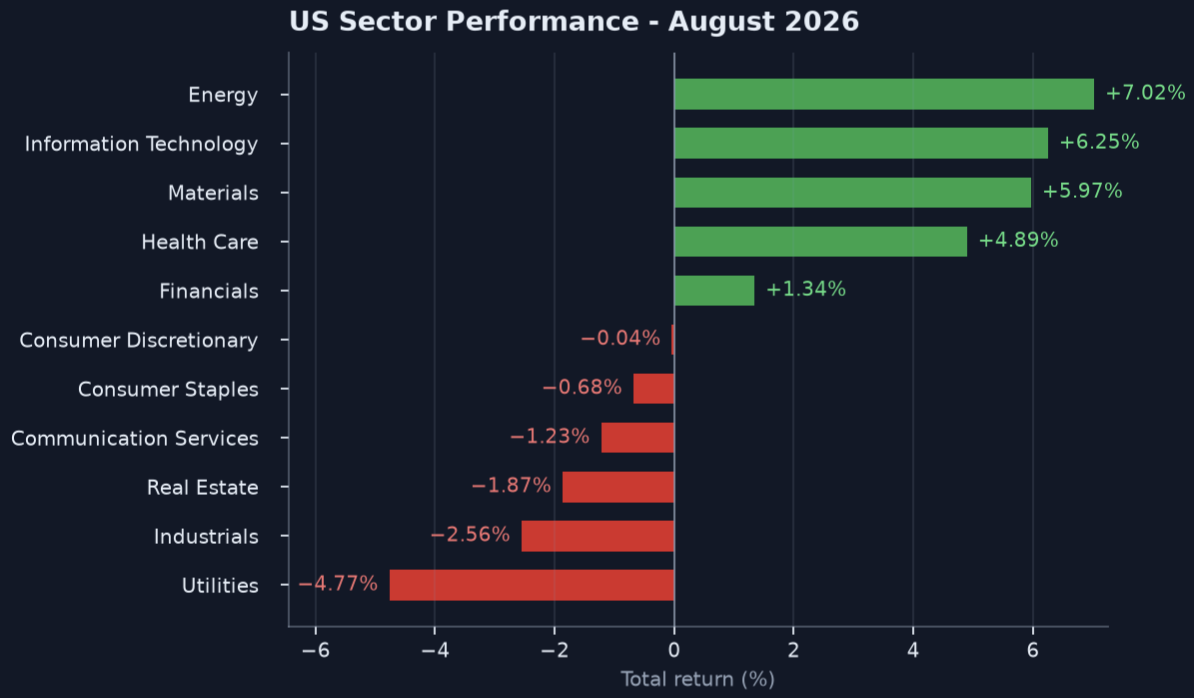
- Growth reclaimed the lead. S&P 500 +2.72%, Nasdaq +3.99%; Russell 2000 +0.98%, S&P Equal-Weight +2.06%. Energy +7.02%, Information Technology +6.25%, and Materials +5.97% led; Utilities -4.77% and Industrials -2.56% lagged.
- Oil round-tripped. WTI +2.68% on the month, a modest result that hides the path: crude sold off hard in the first week as July's war premium drained, then recovered it as the Strait of Hormuz stayed shut. Energy was still the top sector.
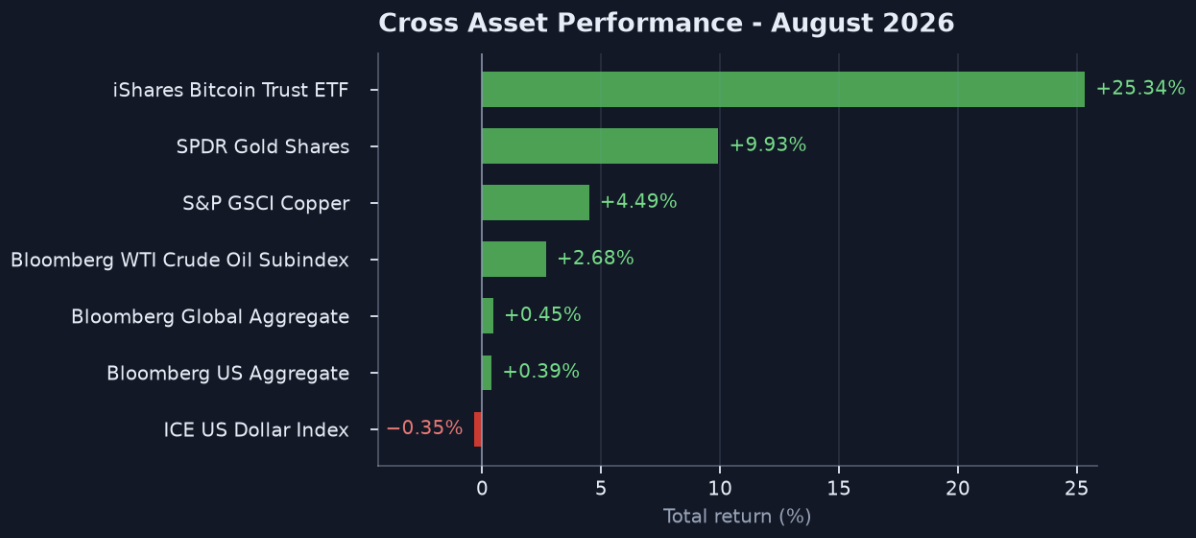
- Real assets led. Bitcoin (IBIT) +25.34%, Gold +9.93%, Copper +4.49%, US Dollar -0.35%. Hot inflation, easy financial conditions and a closed Strait of Hormuz were the backdrop, and real assets led the month.
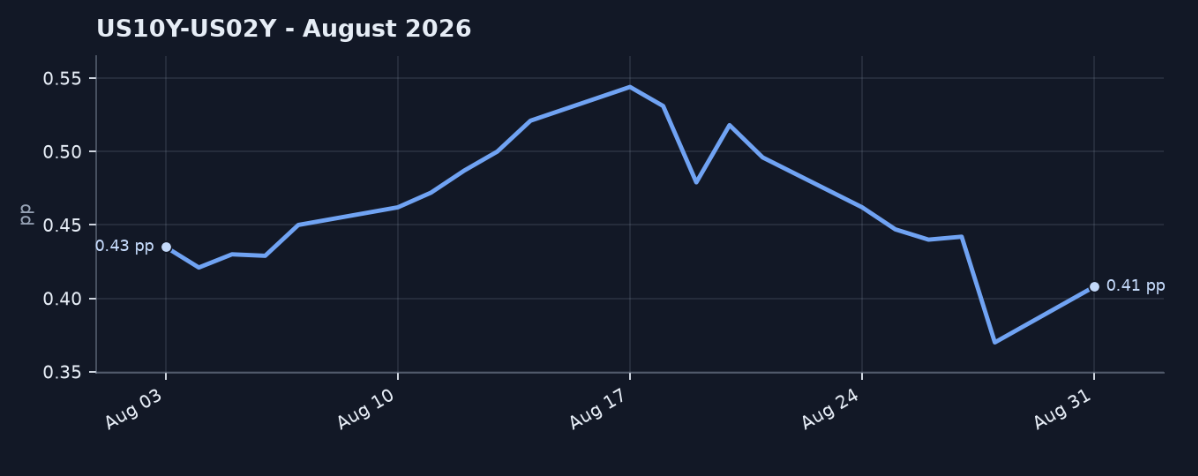
- Income carried the bond market. Bloomberg US Aggregate +0.39%, Global Aggregate +0.45%. The 10-year ended at 4.75% and the curve flattened to +0.41pp as the front end repriced on the Fed, so higher yields limited the price contribution.
Noteworthy developments
What Jackson Hole repriced
For most of August the market was pricing a Fed that was done. Payrolls came in soft, producer prices missed to the downside, retail sales contracted, and headline CPI cooled to 3.4%. By the third week investors had priced the next hike close to out of the curve, and risk assets ran with the falling rate expectations: the S&P 500 peaked on August 13, gold ran to its high on August 24, and Bitcoin gained more than 25% over the month. Separately, on August 19 Treasury announced it would at least double the size of its long-end liquidity-support buybacks beginning September 9, a step aimed at improving functioning in longer-dated Treasuries rather than at the level of yields. Then Warsh spoke on August 28 and said inflation was still too high. Pricing for the December 2026 policy rate moved by roughly half a hike in one session, and the 2027 path moved more; by month-end the market was pricing about 1.36 hikes through December 2026 and 2.24 through 2027. Two things are worth holding onto. First, the repricing landed in rates and in gold, and it did not reach credit or equity volatility, both of which finished the month calmer than they started it. This was a change in the expected path of policy rather than a growth scare. Second, nothing in the month's data said the economy had turned. Warsh described an economy still running hot, and drew the policy conclusion the market had stopped pricing.
U.S. equities: growth reclaims the lead
August reversed July almost line for line. Where a rising discount rate had punished long-duration growth in July, a falling one rewarded it for most of August: Information Technology rose 6.25% after falling 3.43% the month before, and the Nasdaq gained 3.99% against a 2.72% rise in the S&P 500. Energy still finished on top at 7.02% as crude recovered its early-month drop, and Materials added 5.97% on firmer copper. Health Care gained 4.89%. The laggards were the rate-sensitive and the AI-adjacent industrial complex: Utilities fell 4.77%, the worst sector of the month, as investors backed away from the power-buildout trade, Industrials fell 2.56% against softening manufacturing surveys, and Real Estate fell 1.87%. Breadth narrowed as leadership concentrated: the cap-weighted S&P 500 (+2.72%) beat the equal-weight index (+2.06%), and the Russell 2000 (+0.98%) trailed both, unwinding some of July's broadening. All 3 still finished higher, so this was concentration inside a rising market rather than a breadth breakdown.
- Indices: S&P 500 +2.72% · Nasdaq Composite +3.99% · Russell 2000 +0.98% · S&P 500 Equal-Weight +2.06%.
- Sector leaders: Energy +7.02%, Information Technology +6.25%, Materials +5.97%, Health Care +4.89%, Financials +1.34%, Consumer Discretionary -0.04%.
- Sector laggards: Consumer Staples -0.68%, Communication Services -1.23%, Real Estate -1.87%, Industrials -2.56%, Utilities -4.77%.
- Takeaway: Technology and energy led a solid month for U.S. stocks as the market spent most of August expecting the Fed to stay put. Gains concentrated in the largest companies again, and the last week of the month took a little back once the Fed's message turned hawkish.
International markets: semiconductors lead the snapback
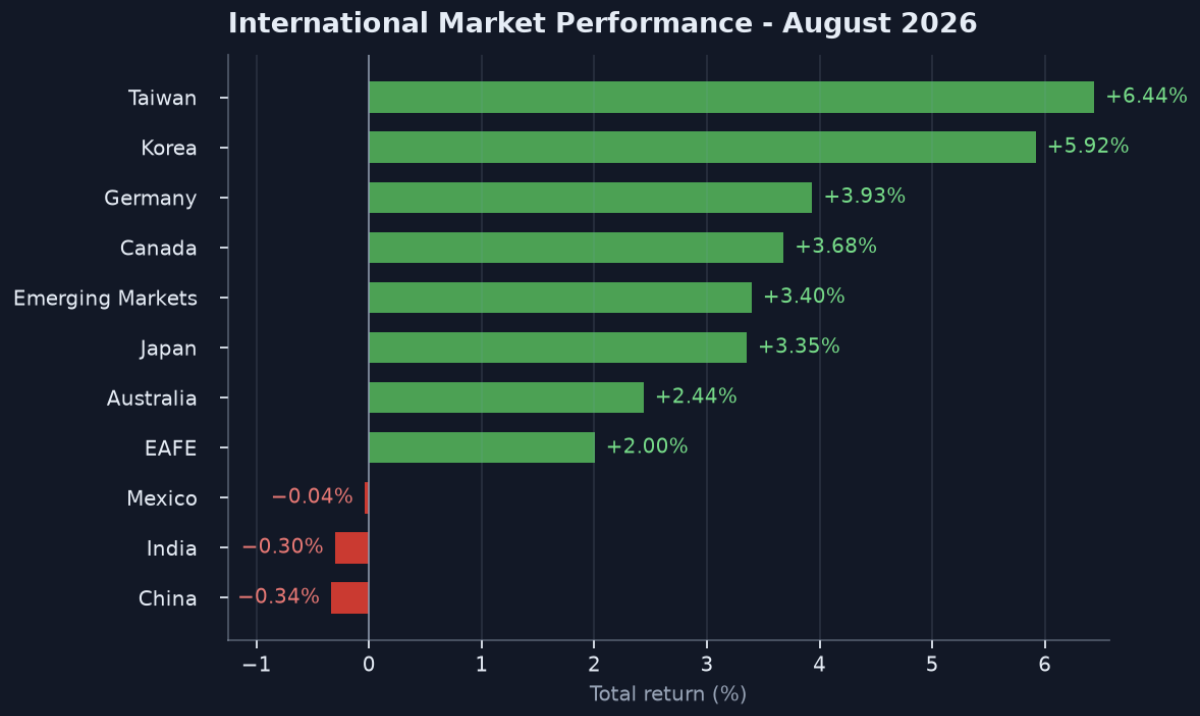
International equities were broadly higher in August, and the leadership was the mirror image of July. MSCI EAFE returned 2.00% and emerging markets 3.40%. A slightly weaker dollar, down 0.35%, added a little to unhedged returns.
Taiwan (+6.44%) and Korea (+5.92%) led, recovering a meaningful share of the semiconductor de-rating that made Korea the worst major market in July. Tight memory supply and continued AI server demand pulled the chip complex back up, and both markets are concentrated enough in that one industry to move with it. Germany (+3.93%) reached record territory on strong earnings and exposure to the same AI infrastructure build, and Canada (+3.68%), Japan (+3.35%) and Australia (+2.44%) all participated. Only 3 major markets finished lower, and barely: China (-0.34%), India (-0.30%) and Mexico (-0.04%) each gave up less than half a percent.
For internationally diversified portfolios, August is a reminder of how much single-industry concentration drives country returns. Korea and Taiwan were the worst markets in July and 2 of the 3 best in August, and the semiconductor cycle explains both.
- Up: Taiwan +6.44%, Korea +5.92%, Germany +3.93%, Canada +3.68%, Japan +3.35%, Australia +2.44%.
- Down: Mexico -0.04%, India -0.30%, China -0.34%.
- Broad benchmarks: MSCI EAFE +2.00%, MSCI EM +3.40%.
- Takeaway: Nearly every major international market rose, led by Taiwan and Korea as semiconductor stocks recovered from a sharp July selloff. Europe also did well, and the weakest markets, China, India and Mexico, were roughly flat rather than down.
Fixed income: the coupon carried the month
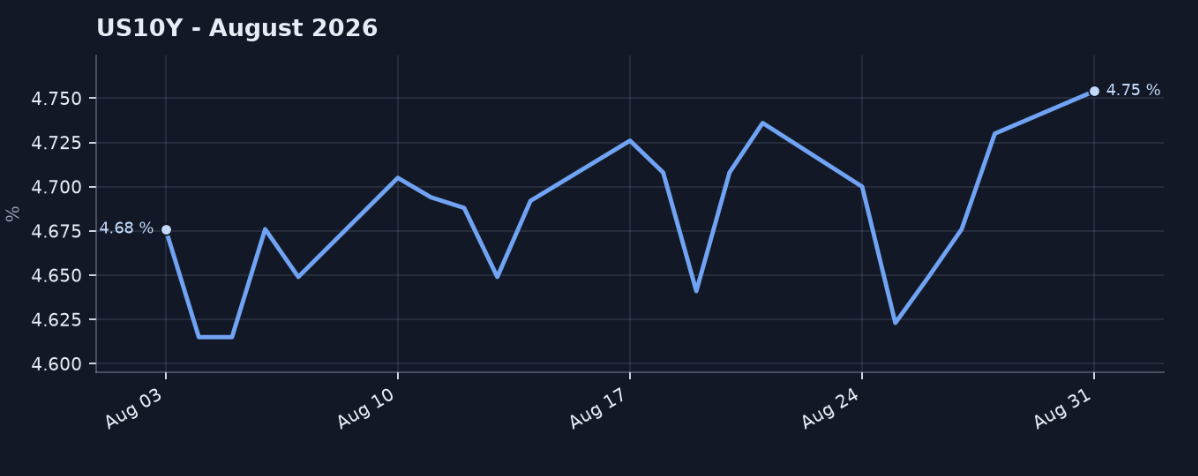
Bonds finished slightly higher, with income carrying the month. The Bloomberg U.S. Aggregate returned 0.39% and the Global Aggregate 0.45%. The path is more interesting than the result. The 10-year Treasury yield fell to 4.62% in the first week as the soft data landed, traded sideways through Treasury's August 19 announcement that it would at least double its long-end liquidity-support buybacks from September 9, and then finished at 4.75%, above where it started and at its high for the month, after Jackson Hole. The 2s10s curve flattened from +0.46pp to +0.41pp, with the compression arriving in the final days as the front end absorbed the hawkish message. That is the shape of a policy repricing rather than a growth scare: hot inflation and firm growth kept the pressure on yields all month.
- Bloomberg US Aggregate +0.39%, Global Aggregate +0.45%.
- The 10-year ended at 4.75% after touching 4.62% early in the month, with 2s10s flattening from +0.46pp to +0.41pp.
- Takeaway: Bonds made a small gain in August, and it came from interest income as higher yields limited the price contribution. Yields ended the month higher than they started after markets read the Fed as reopening the door to tightening, so bonds still pay a healthy coupon, and the price risk in longer maturities has not gone away.
Commodities: gold's month, and oil's round trip
Gold rose 9.93%, its strongest month since January. Three forces stacked: falling expectations for Fed hikes through most of the month, continued strong central-bank buying as reserve managers keep diversifying, and persistent concern about the fiscal path, sharpened by Treasury's announcement that it would enlarge its long-end buyback operations. Gold peaked on August 24 and gave back part of the gain once Warsh spoke, which is the sensitivity a hawkish repricing would imply. Bitcoin (IBIT) rose 25.34% on the same impulse, helped by the drop in long-end yields and by heavy inflows. Copper gained 4.49%, consistent with the firm industrial demand the growth data described. Oil ended up 2.68%, a modest number that conceals a violent path: crude fell sharply in the first week as the war premium built in July drained away, then climbed back through the third week as the Strait of Hormuz remained closed and tanker attacks continued. The dollar slipped 0.35%, which suggests this was not a conventional dollar-led risk-off move.
- WTI crude +2.68%; S&P GSCI Copper +4.49%.
- Gold +9.93%; Bitcoin (IBIT) +25.34%; US Dollar -0.35%.
- Takeaway: Gold had its best month since January, up nearly 10%, as investors bought protection against inflation and government borrowing. Oil finished only slightly higher after a sharp drop and an equally sharp recovery, and the weaker dollar points away from a conventional rush to safety.
Key dates to watch in September 2026
Growth
- Sep 1: ISM Manufacturing PMI.
- Sep 3: ISM Non-Manufacturing PMI.
- Sep 4: Nonfarm Payrolls, Unemployment Rate.
- Sep 16: Retail Sales.
Inflation
- Sep 11: CPI, Core CPI.
Financial conditions
- Sep 16: Fed Interest Rate Decision.
The bottom line
August was a good month that ended on a warning. The macro backdrop barely moved through it: growth above trend, inflation hot but easing at the edges, financial conditions easy, and geopolitics deteriorating as the Strait of Hormuz stayed shut. What changed at the end of the month is the policy path, not the economy. Warsh told us at Jackson Hole that inflation is still too high, and by month-end the market was pricing roughly 1.36 hikes through December 2026 and 2.24 through 2027. The gap he is pointing at is wide: headline PCE is running at 3.7% and core PCE at 3.3%, against the Fed's 2% objective. We stay constructive on the economy, and we see little reward in extending duration while the Fed is signalling that its work on inflation may not be done. The September 16 meeting is now live, and the payroll and inflation prints that precede it matter more than they have all year.


Anshul Sharma is Chief Investment Officer at Savvy Wealth, where he oversees the firm’s investment strategy, portfolio design, and platform innovation. He partners across product, marketing, and operations teams to deliver portfolios that take a methodological approach to balance customization with scalability for advisors and their clients. Before joining Savvy, Anshul spent nearly two decades at Bank of America, where he managed the Chief Investment Office’s Sustainable Model Portfolio Suite, launched new proprietary offerings, and, as Head of Alternative Investment Strategy, provided guidance and thought leadership to advisors around hedge fund, private market, and real asset strategies. He began his career as an Investment Strategist at U.S. Trust, designing multi-asset portfolios for high-net-worth and institutional clients. Anshul holds a Master of Financial Engineering from UC Berkeley and a Bachelor of Computer Engineering from Lehigh University. Outside of work, he is an avid tennis player, enjoys time with his wife, two sons, and their Bernedoodle, and is an auto enthusiast who loves cooking and travel.

Ani Vedere is a Senior Research Analyst at Savvy Wealth, where he works across macro research, portfolio construction, and investment technology. He partners closely with the Chief Investment Officer and cross-functional teams spanning product, engineering, and design to develop scalable investment solutions, advisor-facing tools, and research workflows that help advisors deliver better outcomes for clients. Prior to joining Savvy, Ani was an Investment Analyst at a registered investment advisor, where he managed model portfolio implementation across hundreds of client accounts and built automated research and portfolio monitoring systems using Python and AI. Before that, he spent four years at a discretionary global macro hedge fund conducting multi-asset research, developing systematic investment frameworks, and building analytics to support portfolio management and trading decisions. Ani holds a Bachelor of Science in Finance from the University of Connecticut. Outside of work, he enjoys spending time outdoors, watching movies (in theatres!), reading, and writing. Fair warning: ask him about markets or macroeconomics, and you may end up in a much longer conversation than you planned.
Material prepared herein has been created for informational purposes only and should not be considered investment advice or a recommendation from the Savvy Investment Team. Information was obtained from sources believed to be reliable but was not verified for accuracy.
Savvy Wealth Investment Management (“SWIM”) is a proprietary, in-house investment solution offered by Savvy Advisors, Inc. (“Savvy Advisors”). It is designed to support financial advisors in the management of client portfolios. Savvy Wealth Investment Management is not a separate legal entity and is not independently registered as an investment adviser. All advisory services are provided by Savvy Advisors in its capacity as a registered investment adviser.