



ESG vs. SRI vs. Impact Investing: A Guide for Values-Driven Investors

ESG (Environmental, Social, and Governance) investing has become a common entry point for investors who want their money to reflect more than financial goals. Still, terms like ESG, SRI (Socially Responsible Investing), and impact investing often get grouped together, despite working in very different ways. For affluent investors managing larger portfolios, those differences shape how assets are allocated, how returns are measured, and how real-world outcomes appear over time.
Below, we’ll break down each approach in plain language and explain how sustainable investing fits into performance, taxes, and portfolio design. This way, your values and investment strategy can coexist without guesswork.
Key Takeaways
- While often grouped together, these three approaches have unique objectives:
- ESG (Environmental, Social, Governance): Focuses on financial risk integration. It evaluates how non-financial factors (like labor practices or board oversight) impact a company’s long-term performance and resilience.
- SRI (Socially Responsible Investing): Focuses on values-based exclusion. It uses screens to remove specific industries (e.g., weapons, tobacco) or companies that conflict with an investor's ethical considerations
- Impact Investing: Focuses on measurable outcomes. It targets specific results—such as reduced emissions or affordable housing units built, alongside financial returns, often prioritizing intent over liquidity.
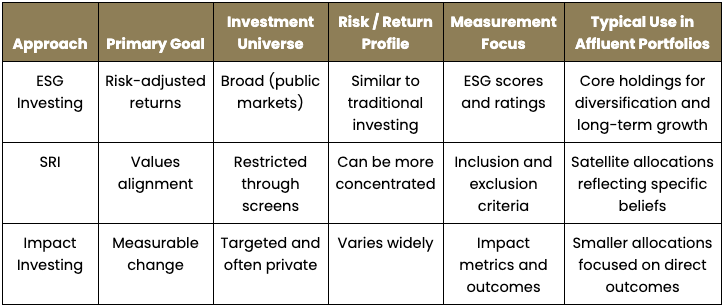
- Affluent investors often combine these strategies into a layered portfolio. A typical structure involves using broad ESG ETFs as the "core" (60-70% of assets) for diversification, with SRI strategies as "satellite" positions (15-25%), and high-impact private investments (5-15%) for direct outcomes.
- Recent data challenges the myth that values-driven investing sacrifices returns. In the first half of 2025, sustainable funds posted a median return of 12.5%, outperforming the 9.2% return of traditional funds.
- True impact investing is defined by "additionality,” the specific positive change that would not have occurred without that capital. This is often achieved through pathways like "Sacrifice" (accepting below-market returns) or "Support" (providing technical assistance to the investee).
- Direct indexing offers an alternative to pooled funds. It allows for granular control to exclude specific stocks based on personal values (e.g., ESG priorities) while enabling tax-loss harvesting at the individual security level to boost after-tax returns.
Defining the Three Pillars of Values-Based Investing
Values-based investing generally falls into three categories: ESG, SRI, and impact investing. While they often overlap, each approach uses different tools to connect capital with personal priorities, financial goals, and desired outcomes. As such, understanding impact investing vs. ESG and ESG vs. SRI begins with how each strategy defines success.
ESG Investing: Risk Integration & Management
ESG investing integrates environmental, social, and governance factors directly into financial analysis. Instead of excluding companies entirely, an ESG investment strategy evaluates how issues like climate exposure, labor practices, executive compensation, and board oversight impact long-term business performance. The core belief is that ESG factors carry financial weight and can signal future resilience or weakness before it shows up in earnings.
This approach sits firmly in the mainstream investment world. Portfolio managers use ESG data alongside revenue growth, margins, and balance sheets to manage risk and identify durable companies. ESG investing often appeals to investors who want competitive, long-term returns while accounting for risks that traditional financial statements might overlook.
Socially Responsible Investing (SRI): Values-Based Exclusion
Socially responsible investing takes a more values-forward stance. Rather than focusing on risk signals, SRI investing begins with what an investor wants to avoid. Standard screens exclude industries such as tobacco, alcohol, weapons, fossil fuels, or gambling. Some SRI strategies also favor companies with strong environmental or labor records. However, exclusion is still the foundation.
Many SRI portfolios apply specialized screens tied to personal or institutional beliefs. These could include faith-based guidelines or alignment with global frameworks like the UN Global Compact. SRI works best for investors with clear ethical boundaries who want their portfolios to reflect those lines, even if it narrows the investment universe or shifts sector exposure.
Impact Investing: Intentional Change
Impact investing focuses on intent and measurement. These investments aim to generate measurable social or environmental outcomes alongside financial return. Unlike ESG or SRI, impact investing targets specific results, like affordable housing units built, emissions reduced, or jobs created in underserved communities.
True impact investing is often defined by three principles: intentionality, measurement, and additionality. Additionality occurs through three pathways: Sacrifice, where investors accept below-market returns; Savvy, where investors identify opportunities others overlook; and Support, where active involvement increases impact through engagement or technical assistance.
The Sacrifice pathway offers the most evident proof of additionality because it shows capital flowing where conventional investors would not. Impact investing appeals to investors who want direct accountability for outcomes and are comfortable with less liquidity or different return profiles.
Quick Comparison Table
Performance, Scoring, and Market Realities
Questions about returns, data quality, and credibility often slow adoption of values-based strategies. Investors want proof that these approaches can compete financially and rely on sound information. Understanding market data and scoring systems separates durable strategies from surface-level claims.
Returns and Market Performance Myths
A common belief is that ESG funds and other values-based strategies trade performance for principles. Market data continues to challenge that view. ESG investing focuses on financially material risks, which often appear during periods of volatility. Companies with strong governance, stable labor practices, and lower regulatory exposure tend to hold up better over long cycles.
Recent performance data supports this trend, as sustainable funds posted median returns of 12.5% in the first half of 2025, compared to 9.2% percent for traditional funds. This marked the strongest period of outperformance since tracking began in 2019. For SRI strategies, investors must manage sector concentration caused by exclusions, but mindful diversification and periodic rebalancing can reduce that exposure without abandoning core values.
ESG Scoring Integrity and Greenwashing
Not all ESG data tells the same story. Different rating agencies apply various methods, which explains why a single company can earn mixed results. MSCI (Morgan Stanley Capital International) uses a letter-grade system from AAA to CCC that compares companies within the same industry and blends ESG analysis with financial metrics. Sustainalytics assigns numerical risk scores from 0 to 100 based on absolute ESG risk across sectors. These structural differences lead to wide score variation rather than data errors.
This inconsistency creates space for green investing claims that lack substance. Investors should watch for vague sustainability language, limited disclosure, or branding that outweighs measurable actions. Third-party standards such as B Corp certification or 1% for the Planet offer clearer signals. Advisor due diligence remains essential, especially as the impact investing market grows.
Portfolio Construction for Affluent Investors
Affluent investors often combine multiple values-based strategies within a single portfolio. This layered approach allows personal priorities to coexist with diversification, liquidity needs, and long-term growth goals. Portfolio design is equally essential as values selection.
The Tiered Portfolio Model
A tiered structure gives values-driven investors flexibility without overconcentration. The core of the portfolio often holds broad-market ESG ETFs (Exchange-Traded Fund), which provide diversification, daily liquidity, and lower costs. This core usually represents 60-70% of assets and serves as the return engine.
The next layer uses SRI strategies to apply targeted exclusions or focus on specific themes such as clean energy or workforce practices. This satellite allocation generally falls between 15 and 25%. The final layer dedicates 5 to 15% to impact investing funds, private placements, or community development projects. These investments aim for measurable outcomes and often carry longer time horizons and lower liquidity.
Customization through Direct Indexing
Direct indexing allows investors to move beyond off-the-shelf ESG portfolios. Instead of owning a single fund, investors hold individual securities that track an index while applying personalized ESG or SRI screens. This approach supports custom exclusion lists, factor tilts, and blended frameworks within one ESG portfolio.
Direct indexing also gives you meaningful tax advantages. Investors can harvest losses at the individual security level throughout the year, which improves after-tax results compared to pooled funds. Most platforms require minimum investments between $25,000 and $500,000, making this strategy best suited for high-net-worth households that desire control and tailored values integration, as well as tax flexibility.
Tax and Philanthropic Optimization
Values-based investing often intersects with tax planning and charitable goals. For affluent investors, purposeful placement and giving structures can reinforce both financial priorities and personal causes without reshaping the entire portfolio.
Tax-Efficient Implementation and Giving
Some impact investments generate ordinary income or limited liquidity, which makes account placement a critical decision. Many investors hold these assets inside retirement accounts, where current tax exposure doesn’t apply. This approach keeps taxable accounts focused on more tax-efficient holdings.
Charitable tools also play a role. Donor-advised funds allow investors to contribute appreciated assets, receive an immediate deduction, and direct grants over time to causes that match their values. Qualified Opportunity Zones can support community development while offering deferral and potential reduction of capital gains. For families with foundations, program-related investments provide a way to fund mission-driven projects while remaining consistent with charitable objectives.
Working with a Specialist Advisor
Values-based investing adds more decision-making that goes beyond standard portfolio design. A specialist advisor brings experience in sourcing investments, reviewing data, and tracking outcomes across public and private markets.
Advisor Due Diligence and Comprehensive Planning
Investors should ask how an advisor evaluates ESG data, selects SRI screens, and sources impact opportunities. Transparent answers around measurement standards, reporting frequency, and third-party verification matter, particularly for private impact investments. Advisors should also explain how they review managers over time and when they exit positions that no longer meet stated goals.
Values often shape broader planning decisions as well. Advisors can integrate portfolio choices with estate planning, family governance, and discussions about multigenerational wealth. Regular reporting on financial performance and impact outcomes keeps the entire plan connected and transparent.
Bringing Values and Wealth Together
Values-driven investing works best when clarity replaces labels and intentions connect to action. ESG, SRI, and impact investing each serve a different role, and no single approach fits every investor. The ideal mix depends on priorities, time horizon, tax profile, and the level of involvement an investor wants in shaping outcomes.
Next Steps
- Clarify which issues matter most and where flexibility exists within your portfolio.
- Review current holdings to understand how ESG, SRI, or impact themes already appear.
- Decide how much liquidity and return variability you can accept for the targeted impact.
- Explore tax-aware structures that support both investing and charitable goals.
Schedule Your Consultation with Savvy Today
FAQs
Is ESG investing the same as sustainable investing?
Not exactly. ESG investing refers to how environmental, social, and governance factors are used in investment analysis. Sustainable investing is a broader umbrella term that can include ESG, SRI, impact investing, and other strategies focused on long-term societal or environmental outcomes.
What are the three main pillars of ESG?
The three pillars are environmental, social, and governance. Environmental looks at issues like emissions and resource use. Social focuses on labor practices, safety, and community impact. Governance examines leadership structure, shareholder rights, and corporate oversight.
What is the difference between an ESG score and an ESG rating?
An ESG score is typically a numerical measure of risk exposure or performance. An ESG rating often groups companies into categories or letter grades relative to peers. Different providers use different methods, which is why scores and ratings can vary widely for the same company.
Can individuals invest in ESG?
Yes. Individual investors can access ESG strategies through mutual funds, ETFs, direct indexing, and separately managed accounts. Many platforms now allow investors to apply ESG screens or preferences without needing institutional-level assets.
What is the 7606 SEC rule?
Rule 7606 comes from the JOBS Act and created the legal framework for crowdfunding investments. It allows smaller companies, including some impact-focused businesses, to raise capital from a broader pool of investors under specific disclosure and investment limits.


Works Cited
- Viewpoint: The three pathways to impact investing additionality
- Sustainable Funds Beat Traditional Funds in First Half of 2025
- A comparison of MSCI and sustainalytics ESG Ratings
Material prepared herein has been created for informational purposes only and should not be considered investment advice or a recommendation. Information was obtained from sources believed to be reliable but was not verified for accuracy. All advisory services are offered through Savvy Advisors, Inc. (“Savvy”), an investment advisor registered with the Securities and Exchange Commission (SEC).