



How to Know If Your Financial Advisor Is Acting in Your Best Interest

A financial advisor fiduciary duty is the legal standard that requires an advisor to put your interests first. A professional title or a long-standing relationship doesn't guarantee your advisor acts as a fiduciary. You can check four things for yourself:
- The legal standard your advisor follows
- How your advisor is registered
- How your advisor is paid
- Whether your accounts show conflicts of interest
Key Takeaways
- An investment advisor owes you a duty of care and a duty of loyalty. A broker who makes recommendations follows a different standard.
- You can check your advisor's registration and disciplinary history in free public databases.
- Ask your advisor direct questions and get the answers in writing.
- Fee-only means you pay your advisor directly. Your statements show what you pay in dollars.
- If something concerns you, talk to your advisor before you decide to stay or switch.
What Fiduciary Duty Means for Your Advisor
Fiduciary duty has a set legal meaning for financial advisors, and brokers follow a different standard. Some professionals work under both.
The Duty of Care and the Duty of Loyalty
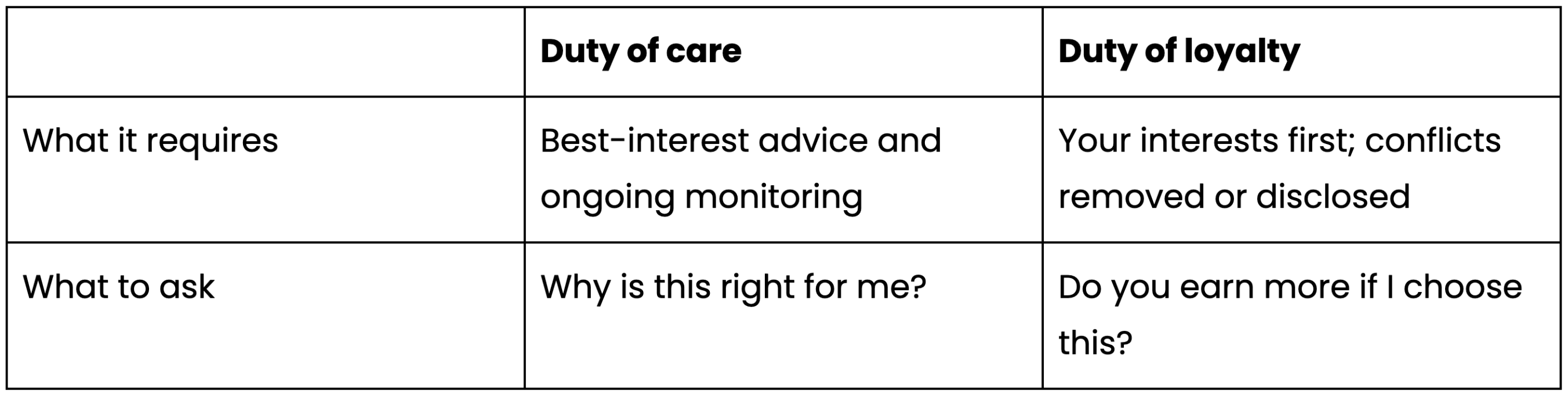
What is a fiduciary advisor? An investment advisor registered under the Investment Advisers Act owes you a fiduciary duty made up of a duty of care and a duty of loyalty. The duty applies to your entire relationship with the advisor.
- Duty of care: Your advisor must give advice in your best interest, based on your goals. Your advisor must also monitor your account as often as your agreement calls for.
- Duty of loyalty: Your advisor may not put their interests ahead of yours. They must remove conflicts of interest or fully disclose them, so you can give informed consent.
How Fiduciary Duty Differs From the Broker Standard
Brokers who recommend investments to retail customers follow Regulation Best Interest. It requires a broker to act in your best interest when making a recommendation. The broker may not put their own financial interest ahead of yours.
Regulation Best Interest applies when a broker makes a recommendation. An advisor’s fiduciary duty applies to the entire relationship. Which one applies to you generally depends on how your advisor is registered and the type of account you hold.
At Savvy Wealth, every advisor is a fiduciary and every engagement is fee-only, with no commissions.
When One Advisor Wears Two Hats
Some professionals are registered both as brokers and as investment advisors. Which standard applies may depend on the role they play for a given recommendation or account.
Your advisor's registration and disclosure documents state which standard they follow. Ask your advisor which role they play for each account. The same check works whether you are reviewing a current advisor or hiring a financial advisor.
Confirm How Your Advisor Is Registered
You can confirm registration yourself, for free.
Search the SEC and FINRA Databases
Search your advisor’s name on the SEC’s Investment Adviser Public Disclosure site and on FINRA BrokerCheck. Look for:
- How your advisor is registered: as an investment adviser, a broker, or both
- Employment history
- Any disciplinary disclosures
A disclosure does not automatically rule someone out. Note the date, the type of event, and whether it involved client money. Vetting a financial advisor includes a full BrokerCheck walkthrough.
Read Your Firm's Relationship Summary and Form ADV
These two documents show how your advisor’s firm works:
- Form CRS (relationship summary): SEC rules require advisers and brokers to give this short summary to retail investors. It covers services, fees and costs, conflicts of interest, the standard of conduct, and disciplinary history.
- Form ADV Part 2 (the brochure): This is an adviser's longer disclosure. It describes the firm's services, how it is paid, any disciplinary events, and other financial industry activities, such as broker registration.
If you do not have both, ask for them.
Ask Five Questions and Get the Answers in Writing
The Department of Labor suggests asking your advisor these questions:
- Do you consider yourself a fiduciary, and will you put that in writing?
- How are you paid?
- Will you earn more if I invest in certain products?
- Will you list, in writing, the fees and commissions you receive?
- Have you or your firm ever been disciplined?
The DOL’s own advice is short: “Trust, but verify!”
Examine How Your Advisor Is Paid
How your advisor is paid affects the incentives behind each recommendation. Start with the label your advisor uses. Then, turn your fee into a dollar amount.
What "Fee-Only" Means and What It Does Not
Fee-only financial advisors are paid directly by their clients and accept no commissions. They may charge an hourly rate, a retainer, a percentage of assets, or a flat fee.
A fee-based or hybrid advisor may charge you a fee and also earn commissions on products. The label alone does not tell you whether product incentives exist.
Fee-only has two limits:
- Fee-only means you pay your advisor. The size of the fee is a separate question.
- Fee-only describes pay. Fiduciary describes the legal duty your advisor owes you. Ask about both.
Turn Your Fee Into a Dollar Amount
Find the total you paid last year. Add the advisory fee, your fund expenses, and any trading costs or product charges on your statements. Here is a hypothetical example of a $2,000,000 portfolio.
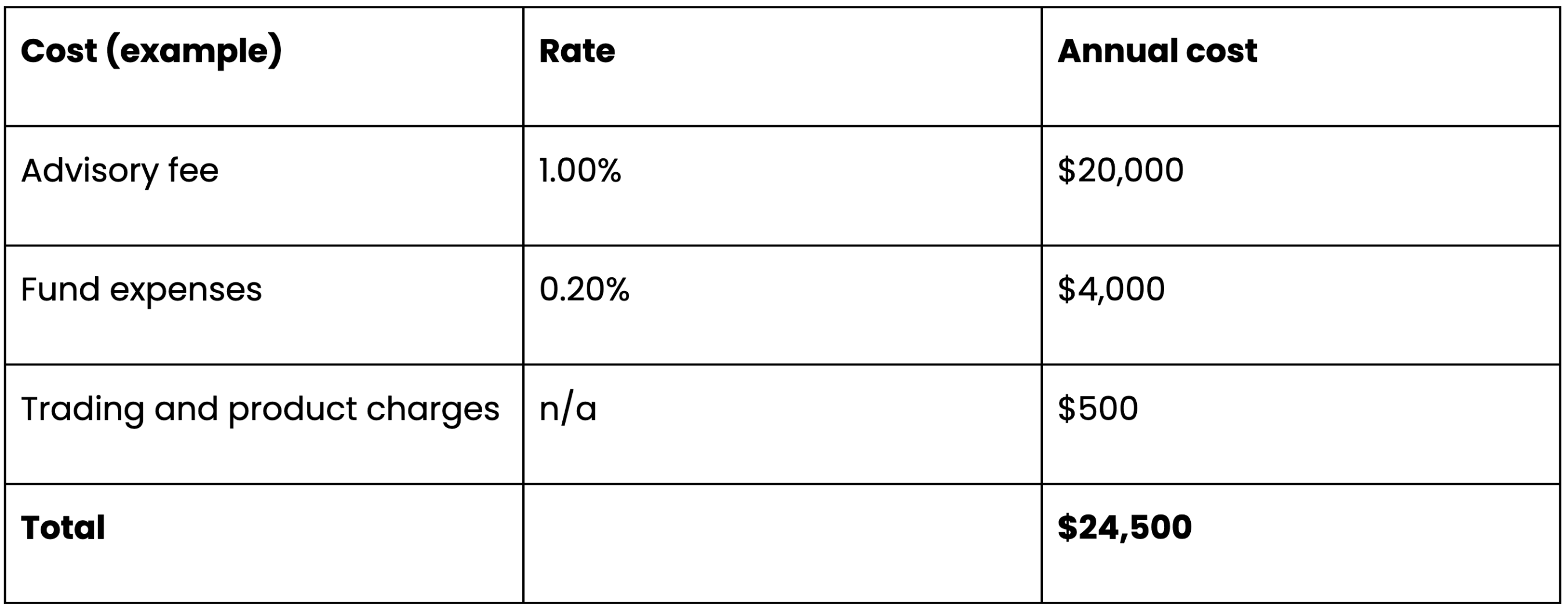
Compare your own total to the services you use. Those may include planning, tax coordination, estate work, and regular reviews. Then decide if the price is fair. Our comprehensive financial planning brings these services into one plan. How much a financial advisor costs varies by pay model, and the typical range for each is easy to compare.
Look for Conflicts of Interest in Your Own Accounts
Investment advisors, brokers, and other financial professionals generally have at least some conflicts of interest. The duty of loyalty requires those conflicts to be removed or disclosed. Your statements and meetings can show you where to ask.
What Your Statements May Show
Review your statements for these items. Each one may have a sound reason, so treat them as questions for your advisor:
- Funds or products from your advisor's own firm or an affiliated company
- Insurance or annuity products that your advisor recommended
- Frequent trading in a portfolio meant for long-term growth
- Funds with higher internal costs when a similar, lower-cost fund exists
None of these items is automatically a problem. Ask your advisor why each one is in your account and how it was disclosed to you.
What Your Meetings May Show
Your documents answer the legal question. Your meetings show how the duty plays out.
- Watch how your advisor answers questions. Ask about fees, conflicts, or other options. Specific, written answers are a good sign. Vague answers or pressure to decide may be worth noting.
- Check for a reason and a schedule. Each recommendation should be accompanied by a rationale tied to your goals, and your plan should be reviewed on the agreed-upon schedule. The duty of care includes monitoring that fits your agreement.
Decide Whether to Stay or Switch
Talk to your advisor first. Then, check the details before you move any accounts.
Raise Concerns With Your Advisor First
Bring your findings to your advisor as questions. A good advisor can usually explain a product choice or a fee and put the answer in writing. A clear, direct response should cover:
- A clear reason tied to your goals
- A written disclosure of any conflict
- A willingness to look at lower-cost or non-conflicted options
If your advisor hesitates to put their answers in writing, it may be time to look for a new partner.
Check the Tax and Account Details Before You Move
Look at your taxable accounts first. Selling investments to change advisors may trigger capital gains tax. Ask whether your investments can move without being sold, and time any sales with taxes in mind.
Some investments cannot be transferred. You may need to sell them or leave them at your old firm. Your old firm may also charge a transfer fee, and the new firm sometimes does as well. Check your account agreement for these fees.
A new advisor can help you plan the move. At Savvy Wealth, our tax-coordinated investing approach means we work with your CPA on decisions such as which positions to sell and when.
Conclusion
Fiduciary duty is the baseline, and you can check it yourself. Confirm the standard, read the registration records, find your cost in dollars, and review your accounts for conflicts. Most of what you need is free and public. If something concerns you, ask your advisor and get the answer in writing.
Want to be sure your advisor meets this standard? Match with a fiduciary financial advisor at Savvy Wealth.
Frequently Asked Questions
What is one potential drawback of using a fee-only financial advisor?
Fee-only costs are paid directly, so they may appear larger than commission costs built into a product. A percentage-of-assets fee also rises as your portfolio grows, so check that the services grow with it.
What is the average fee for a fiduciary financial advisor?
Fees vary by pay model. Advisors who charge a percentage of assets typically charge around 1%, and the rate generally falls as your portfolio grows. Hourly rates commonly run $150 to $300, though they can be higher. Our guide to financial advisor cost covers flat-fee and subscription pricing, too.
What is not considered a fiduciary duty of an advisor?
Fiduciary duty requires best-interest advice and loyalty, and it generally does not guarantee a market result. How much monitoring it requires depends on your agreement, such as whether it's a one-time plan or an ongoing relationship.



Jenna Smith, AFC® is a Financial Advisor based in Orem, Utah, specializing in comprehensive financial planning and the behavioral side of money. She helps individuals and families navigate investments, retirement, taxes, insurance, estate planning, and cash flow. Her passion lies in simplifying complex financial decisions and helping clients understand how their habits, emotions, and experiences influence their financial lives. Through a personalized, education-focused approach, she empowers clients to make informed decisions and build financial plans that align with their goals and everyday lives.

Works Cited
- SEC - Regulation Best Interest: The Broker-Dealer Standard of Conduct
- SEC - Form CRS Relationship Summary; Amendments to Form ADV
- SEC - Uniform Requirements for the Investment Adviser Brochure and Brochure Supplements
- U.S. Department of Labor - How to Tell Whether Your Adviser is Working in Your Best Interest: A Fiduciary Guide for Individual Consumers
- SEC - Commission Interpretation Regarding Standard of Conduct for Investment Advisers
Material prepared herein has been created for informational purposes only and should not be considered investment advice or a recommendation. Information was obtained from sources believed to be reliable but was not verified for accuracy. All advisory services are offered through Savvy Advisors, Inc. (Savvy Advisors), an investment advisor registered with the Securities and Exchange Commission (SEC).

.webp)