



Knowing how to vet a financial advisor before you hire them is vital for high-net-worth individuals. With important assets on the line, picking the wrong person can lead to missed tax efficiencies, misaligned risk, and compounding losses.
This may all seem overwhelming, especially because a 2023 study found that 56% of Americans feel anxious about their finances. To protect your wealth, utilize our six-step framework: verify fiduciary status, evaluate credentials, run background checks, decode fee structures, spot red flags, and master the discovery call.
Match with a Financial Advisor!
Key Takeaways
Here are a few key takeaways that we’ll be covering below:
- Fiduciary is the Baseline: Never compromise on a 100% fiduciary standard. It’s your only guarantee of legal alignment.
- Verify, Don’t Assume: Look past impressive job titles and independently confirm that credentials and background histories are active and clean.
- Follow the Money: Unmask the advisor’s true incentives by decoding how they get paid and identifying hidden third-party conflicts.
- Interview with Scrutiny: Use the discovery call as a rigorous intake interview to test transparency, specialization, and structural fit.
Step 1: Confirm Fiduciary Status – It’s the Only Non-Negotiable
Determining an advisor’s legal obligation is the first step that you should take, as fiduciary status is the most important question. If a candidate cannot pass this initial test, you shouldn’t have them managing your wealth.
Fiduciary vs. Suitability: The Legal Difference That Protects Your Assets
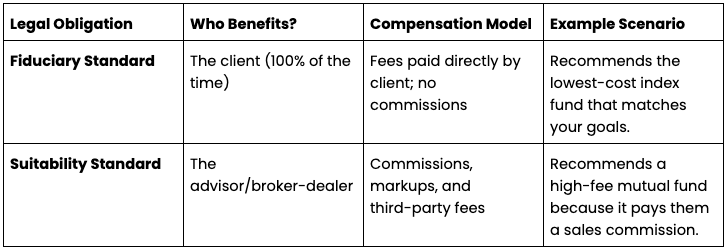
Advisors operating under the suitability standard can only recommend products suitable for you. This lets them push higher-cost options that put more money in their own pockets over cheaper, identical alternatives.
Conversely, a fiduciary financial advisor has a legal obligation to always act in your best interest, while a fee-only fiduciary eliminates commissions or third-party product kickbacks. Make sure to note this nuance as well: RIAs must legally act as fiduciaries at all times under SEC rules. CFPs, however, are only bound by the fiduciary standard when actively delivering financial advice.
How to Verify Fiduciary Status Before the First Meeting
When vetting a financial advisor, skip the marketing materials and ask them directly: “Are you a fiduciary 100% of the time?” Any person who pauses or says “it depends” is not a fiduciary.
Next, confirm their firm’s status independently. Look up their RIA registration using the SEC’s IAPD tool on their website. Keep in mind that broker-dealers affiliated with major banks or insurance companies generally operate under a lower suitability standard.
Finally, protect yourself by requesting a signed fiduciary commitment letter before signing an official engagement agreement.
Step 2: Verify Credentials – and Confirm They’re Active
Professional credentials are reliable proxies for baseline technical expertise and ethical accountability. Your goal is to match the advisor’s specific knowledge to your financial situation, rather than simply collecting the individual with the most letters after their name.
The Credentials Worth Verifying (and What Each One Signals)
When choosing a financial advisor, prioritize rigorous, verified designations over vague, internal corporate titles.
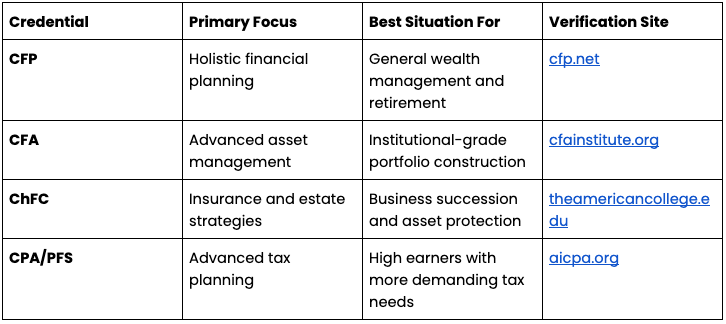
The CFP mark is the industry benchmark for comprehensive financial planning, requiring 6,000 hours of experience and passing a tough exam. The CFA charter signals investment management expertise, which is vital for portfolio construction. For specialized needs, the ChFC focuses on insurance and estate planning, while the CPA/PFS combination indicates elite tax integration for high-net-worth individuals facing sophisticated tax brackets.
Match Specialization to Your Situation
Credentials prove baseline competency. However, they don’t guarantee specialization. Always add this question to your financial advisor checklist: “What percentage of your clients share my exact financial complexity?” If it’s under 20%, you should look elsewhere.
While credentials verify general knowledge, specialization ensures an advisor can get you through HNWI Financial Planning issues such as executive equity compensation, business sales, or multi-generational estate structures.
Step 3: Run a Background Check Before You Meet
Conducting an independent background check is an essential step you must complete before scheduling a meeting. Utilizing two free public tools (e.g., FINRA BrokerCheck and Form ADV) takes less than 15 minutes and protects your money from hidden histories.
How to Use FINRA BrokerCheck – and What Each Disclosure Means
Before meeting, visit brokercheck.finra.org to search the advisor’s name and firm. FINRA notes that BrokerCheck contains records on more than 3,400 registered firms and 630,000 individuals, tracking licensing, exams, and disclosures.
When reviewing, apply the pattern test: Was there more than one incident? Did it involve client money? Is it recent? A dismissed complaint from 12 years ago differs from a recent, settled dispute over client funds. Note that fee-only RIA advisors who never held a broker license won’t appear here; use the SEC’s IAPD instead.
How to Read Form ADV Part 2 – Focus on Conflicts of Interest
Form ADV is an RIA’s mandatory SEC disclosure. Make sure to request Part 2A (the brochure) and PArt 2B directly or download it from IAPD. It’s written in plain English, so it’s very easy to understand.
You’ll want to focus on Part 2A to uncover services, fees, and conflicts. You’ll also want to flag mentions of 12b-1 fees, proprietary product affiliations, or soft dollar arrangements. Watch out for vague language like “may receive compensation” or “has a material conflict” without describing how it’s managed as well. This signals the conflict is active and uncontrolled.
Step 4: Decode the Fee Structure – and the Conflicts It Creates
How your financial advisor gets paid directly dictates whose interests they serve. While there are three primary compensation models across the wealth management industry, only one consistently eliminates toxic incentives and keeps your goals aligned.
Fee-Only vs. Fee-Based vs. Commission: What the Labels Actually Mean
When deciding what to look for in a financial advisor, you need to know the exact definitions behind compensation tools.
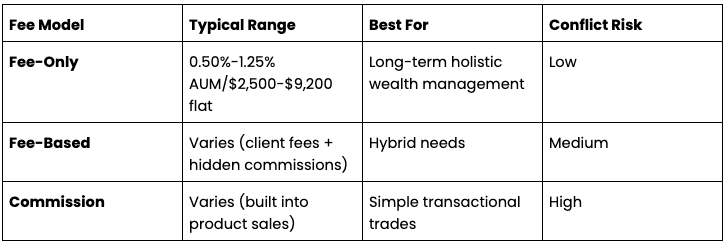
Fee-only advisors are paid exclusively by the client via an AUM percentage, flat retainer, or hourly rate. They accept zero revenue from product companies, offering the cleanest alignment. Conversely, fee-based advisors charge a client fee and earn commissions from selling financial products. This hybrid model, however, contains built-in conflicts of interest.
Commission-only brokers earn money solely by selling products, prioritizing sales volume over the quality of advice. To find out how much a financial advisor costs, ask directly: “Do you receive any compensation from third parties, product companies, or custodians”?
What Normal Fees Look Like – and When to Walk Away
For standard AUM models, fees usually range from 0.50% to 1.25% annually for portfolios between $500K and $2M. Anything scaling above 1.5% for a straightforward portfolio demands a clear, written justification.
If you prefer fixed pricing, a recent study found that flat annual financial planning fees generally range from $2,500 to $9,200, and hourly rates from $200 to $400. You should walk away immediately if a firm refuses to provide a written fee schedule, tries to charge both AUM fees and product commissions, or deflects your pricing questions entirely. Finding a dedicated fee-only advisor helps protect your portfolio from unnecessary costs.
Step 5: Know the Red Flags – Before and During the Meeting
The most telling warning signs often appear long before you look at a background check. You can easily stop critical red flags by simply analyzing marketing materials and observing how a person handles your initial conversations.
Red Flags Before the Discovery Call
Be highly suspicious of any professional who claims guaranteed returns or consistently promises to beat the market. This promotional language violates SEC and FINRA regulations, as no professional can predict or guarantee market performance.
Another warning sign is a missing or heavily guarded fee schedule. If an advisor’s website or biography completely avoids mentioning fiduciary status, active credentials, or RIA registration, you shouldn’t choose them.
Finally, be cautious of advisors who are tied to insurance firms or major banks that push proprietary products, as well as those who source clients through free dinner seminars funded by product companies.
Red Flags During the Discovery Call
Pay close attention to how a person answers direct questions about their compensation. If they use financial jargon or refuse to give a straight answer to “Do you earn money beyond the fee I pay you?”, you should end the conversation.
Furthermore, run if they pitch specific investment products before executing a meaningful intake of your actual balance sheet. A good advisor always diagnoses before prescribing. Also, watch out for people who dismiss your background check questions or treat your screening as an insult. Lastly, avoid them if they fail to address any potential conflicts of interest.
Check out our Financial Advisor Discovery Questions article to learn more about what you should be asking prospective clients.
Step 6: Bring These Questions to the Discovery Call
A prepared question list lets you gather the specific data points needed for an informed decision. It also reveals exactly how a person handles tough professional scrutiny under pressure.
Questions to Qualify the Advisor
When interviewing financial advisors, ask them:
- “Are you a fiduciary 100% of the time, and will you explicitly state that in our engagement letter?”
- “How are you compensated? Do you receive any revenue from third parties, custodians, or product manufacturers?”
- “What credentials do you hold, and where can I independently verify them?”
- “What does your typical client look like regarding net worth, life stage, and financial sophistication?”
Advisors should answer these effortlessly, while evasion is an answer in itself. Savvy’s screening eliminates this initial cold-vetting filter.
Questions to Assess the Fit
To ensure the person can manage your financial needs, ask: “What is your investment philosophy, and how does it hold up in a down market?” as well as “How do you coordinate with my CPA and estate attorney, and who leads when a disagreement arises?”
Conclude with: “What does my client reporting look like, and how do I access my data in real time?” and “Can you describe a specific situation where your recommendation cost you a commission but was the correct advice for the client?” Look for highly specific examples when seeking a good financial advisor to build a comprehensive financial plan.
Conclusion
Vetting a prospective financial professional requires a disciplined, step-by-step approach. Before committing your hard-earned money, make sure to execute these clear final steps: run the advisor’s full name through the FINRA BrokerCheck and SEC IAPD databases, request and carefully read Form ADV Part 2, and bring up specific discovery questions to your first meeting. Taking these precautions helps protect your assets and supports better alignment.
Speak with a Savvy Advisor About Your Goals



I’m Nathan Mirizzi, an Advisor and CERTIFIED FINANCIAL PLANNER™ professional at Blue Barn Wealth, passionate about helping individuals build clarity and confidence around their financial future. I bring energy, analytical focus, and a strong foundation in personal finance to the clients I serve.
 Contact a Savvy advisor
.webp)