



September 2026 Global Markets Recap

Rates broke out, and AI held the index together
September was the month interest rates moved sharply higher. The economy was growing well above its usual pace, and inflation ran hot. Financial conditions, a broad gauge of how easy it is to borrow and raise money, were still looser than average. The Federal Reserve then raised rates for the first time since 2023, and the 10-year Treasury yield ended the month at 5.29%, its highest close since 2002. Bonds and gold lost ground: the Bloomberg U.S. Aggregate returned -2.61% and gold -6.75%. The S&P 500 slipped only slightly (-0.35%), but that headline hides how narrow the market became. The equal-weight S&P 500 (-4.81%), which gives every company the same weight and so tracks the average stock, and the Russell 2000 of smaller companies (-5.25%) fell much further. In the standard, cap-weighted S&P 500, where the largest companies count most, a handful of large AI-linked companies kept the index close to flat.
- Rates rose sharply. The Fed announced a quarter-point increase on September 16, its first since July 2023, and the 10-year Treasury yield rose from 4.75% to 5.29% over the month. Strong growth data, inflation data lifted by energy prices, and Treasury auctions where buyers demanded higher yields all pushed the 10-year yield higher.
- A narrow market. S&P 500 -0.35%, Nasdaq +1.93%. Russell 2000 -5.25%, S&P Equal-Weight -4.81%. Information Technology +4.47% and Communication Services +4.33% were the only sectors to rise. Financials -7.16% and Materials -6.74% lagged.
- Oil rose on a war-driven supply shock. WTI, the U.S. oil benchmark, rose 7.90% on the month, as attacks on tankers around the Strait of Hormuz and Gulf oil production still offline kept supply tight, though prices swung in the second half as hopes for talks with Iran rose and faded. Higher fuel costs were already showing up in August's inflation data.
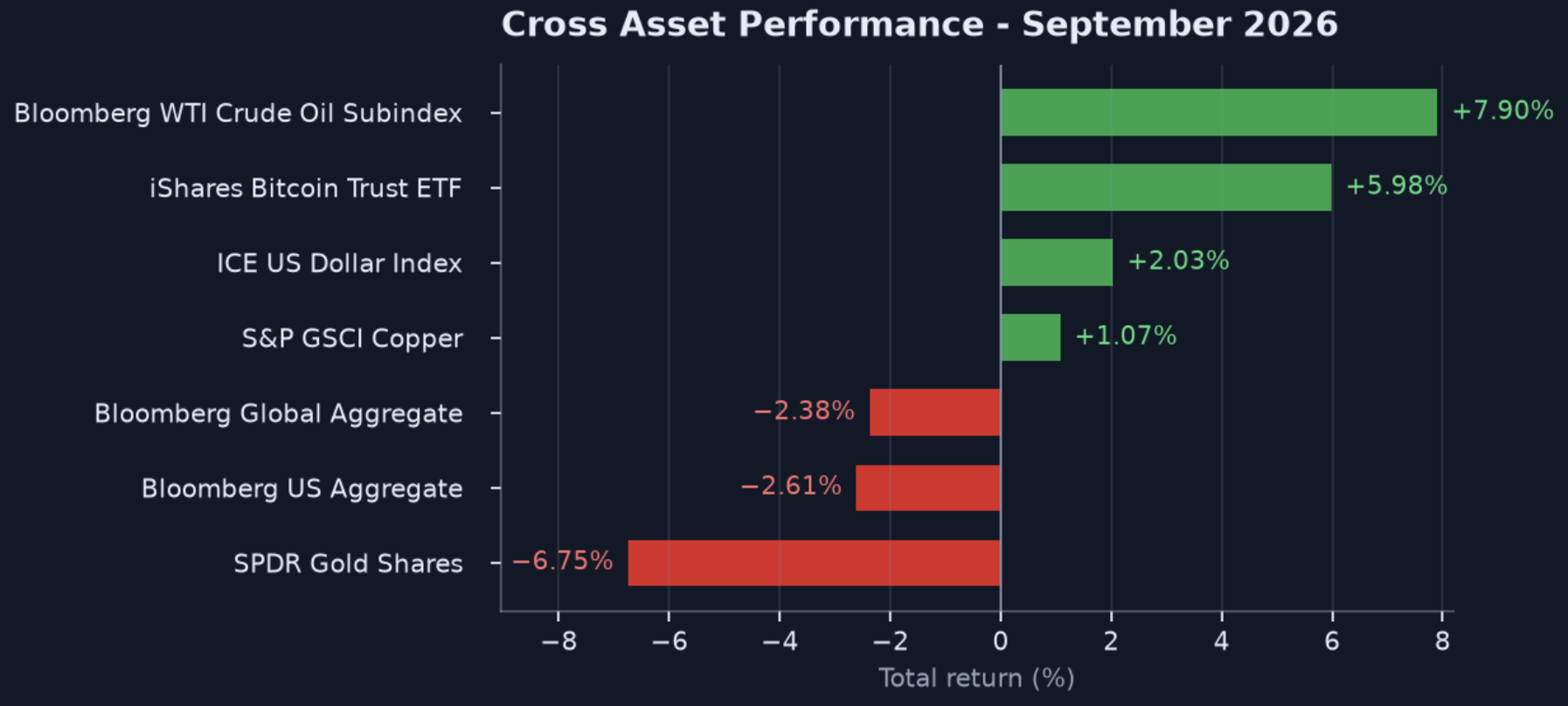
- Other assets. Bitcoin (IBIT) +5.98%, Gold -6.75%, US Dollar +2.03%. A stronger dollar and higher yields weighed on gold, while bitcoin rose as money flowed back into U.S. bitcoin funds.
- Bonds lost ground. Bloomberg US Aggregate -2.61%, Global Aggregate -2.38%. High-yield credit spreads (the extra yield riskier companies pay to borrow) widened to their widest level since early April.
Noteworthy developments
How the 10-year reached 5%
Long-term yields rose in 2 stages, and the Fed's decision sat between them. The first stage was about inflation and the Fed. On September 3, Governor Christopher Waller said that if August data showed progress on inflation had been fleeting, it may be appropriate to raise rates at the mid-September meeting. The data that followed ran hot. Employers added 162,000 jobs, against expectations near 53,000. Producer prices rose in August, with energy behind more than three-quarters of the increase. Headline CPI rose 0.4% for the month and 3.4% from a year earlier, with gasoline again a large contributor. The 10-year closed at 5% on September 15, its first close at that level since 2007. On September 16 the Fed announced a quarter-point increase to a range of 3.75% to 4%, effective the next day, and officials' median projection put the policy rate at 4.1% by the end of 2026, which implies 1 more increase this year. The 10-year actually slipped the day after the decision, before the next leg higher began on September 23.
In the second stage, from September 23, long-term yields rose faster than short-term yields, and because a bond's price falls when its yield rises, long-term bond prices fell more than short-term ones. On September 23, S&P Global's preliminary survey of U.S. business activity showed its fastest expansion since July 2021. A 5-year Treasury auction that day drew weaker demand than August's. Governor Michael Barr, who had supported the September increase, said further adjustments to interest rates were likely needed in his main scenario. On September 24 the Treasury sold new 7-year notes at the highest yield since April 1993. After President Trump rejected Iran's proposal to reopen the Strait of Hormuz on September 26, oil and yields rose together on the next trading day.
Speaking at his September 16 press conference, before the second stage began, Fed Chair Kevin Warsh offered his own explanation. Asked why longer-term yields had risen, he named economic strength first, then competition for capital as the large cloud and AI companies raise funding, then geopolitics, and he called the causes “overdetermined,” meaning there were more than enough reasons for yields to rise. The month's events fit that list: oil kept inflation elevated, firm growth data kept the Fed leaning toward more increases, and auctions of longer-dated Treasuries found buyers only at higher yields. By month-end, traders were betting on close to 1 more quarter-point increase by December. Through the end of 2027, their bets added up to about 3.6 more quarter-point increases' worth of tightening in total.
U.S. equities: a few AI giants carried a falling market
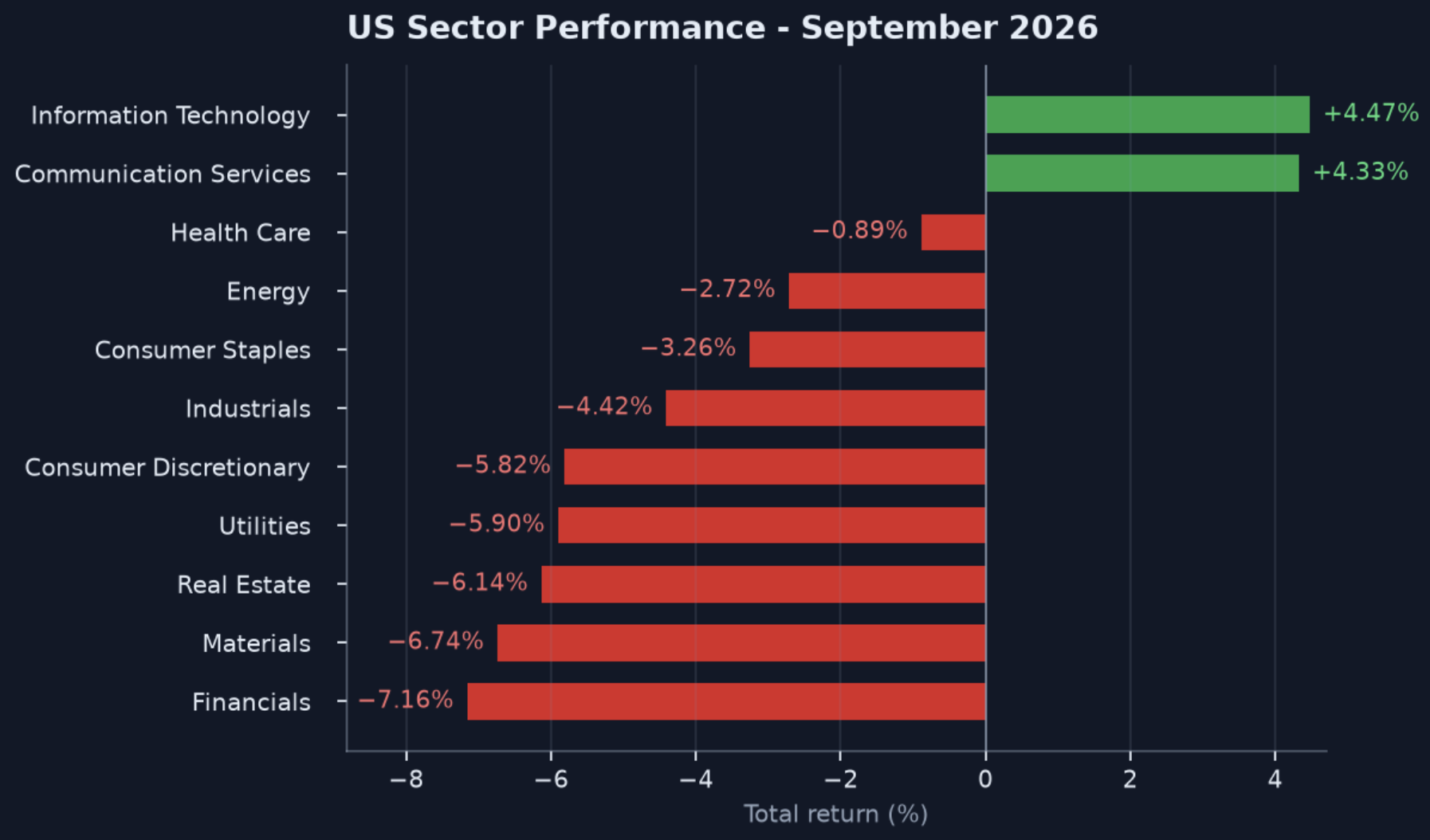
Most U.S. stocks fell in September, and a small group of AI-linked giants kept the headline index close to flat. Information Technology (+4.47%) and Communication Services (+4.33%) were the only 2 sectors to rise. The company news behind them was strong. Broadcom said its AI chip revenue more than tripled from a year earlier, and it forecast more growth for the next quarter. Oracle reported $664 billion of future revenue already under contract. Meta jumped on September 21 after its new AI assistant, Muse, topped Apple's U.S. free app chart, and Wells Fargo raised its price target, its forecast for Meta's share price. Nvidia added $150 billion to its plan to buy back its own shares on September 28. The Nasdaq finished the month up 1.93%. The rest of the market moved the other way. Financials (-7.16%) and Materials (-6.74%) fell most, and Real Estate (-6.14%) and Utilities (-5.90%), sectors that tend to fall when interest rates rise, were close behind. Smaller companies fell further, with the Russell 2000 at -5.25%, and the equal-weight S&P 500 (-4.81%) trailed the cap-weighted index (-0.35%) by more than 4 percentage points. Consumer Discretionary (-5.82%) also fell despite a gain in August retail sales.
- Indices: S&P 500 -0.35% · Nasdaq Composite +1.93% · Russell 2000 -5.25% · S&P 500 Equal-Weight -4.81%.
- Sector leaders: Information Technology +4.47%, Communication Services +4.33%, Health Care -0.89%, Energy -2.72%, Consumer Staples -3.26%, Industrials -4.42%.
- Sector laggards: Consumer Discretionary -5.82%, Utilities -5.90%, Real Estate -6.14%, Materials -6.74%, Financials -7.16%.
- Takeaway: The S&P 500 finished September almost unchanged, but the average stock, measured by the equal-weight index, returned -4.81%. Strong growth and hot inflation pushed interest rates higher, and higher rates weighed on most of the market. A handful of AI leaders did the lifting, which leaves the index more dependent on a few companies than its headline return suggests.
International markets: chipmakers rose, most others fell
International equities fell in September. Developed markets (MSCI EAFE) returned -3.01% and emerging markets (MSCI EM) -0.50%. Central banks abroad tightened alongside the Fed: the European Central Bank raised rates by a quarter point on September 10, the Bank of England held on September 17 with 3 of its 9 members voting to raise, and the Bank of Japan lifted its policy rate to the highest level since 1995 on September 18. The U.S. dollar rose 2.03%, which trims returns for U.S. investors who hold foreign stocks without a currency hedge, because foreign currencies convert back into fewer dollars.
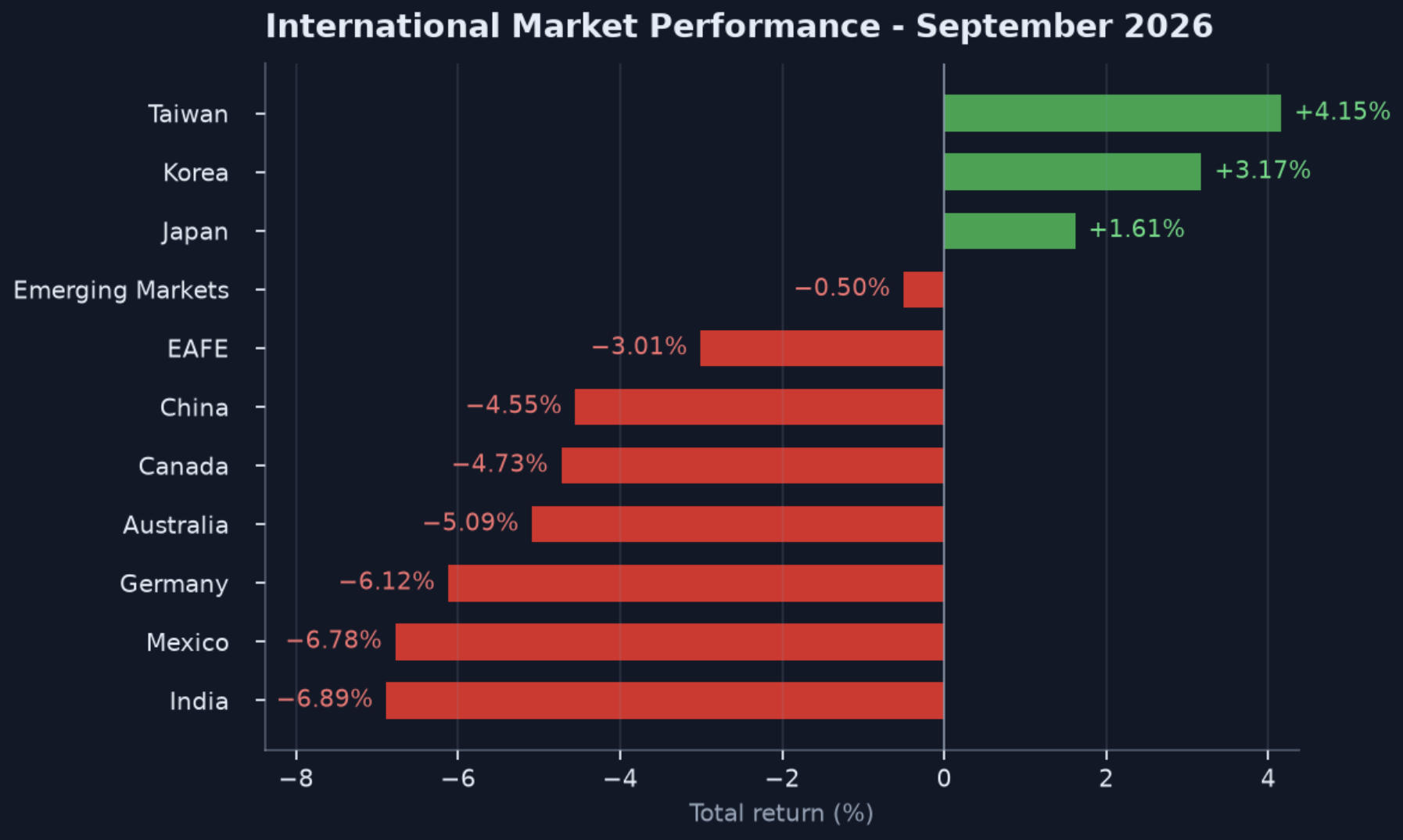
Taiwan (+4.15%) and Korea (+3.17%) led on the same AI hardware demand that supported U.S. technology: Korea's August chip exports more than tripled from a year earlier to a record, and TSMC's August revenue was up more than half from a year earlier. Japan (+1.61%) also rose. India (-6.89%) fell most, as foreign investors sold about $2.7 billion of Indian shares, the most in 6 months, amid higher oil prices and rising global rates. Mexico (-6.78%), Germany (-6.12%), Australia (-5.09%), Canada (-4.73%), and China (-4.55%) also finished lower. In China, talks with the U.S. extended the trade truce into January without a broader deal, and Chinese stocks hit a 1-year low on September 28 on chip-related news.
- Up: Taiwan +4.15%, Korea +3.17%, Japan +1.61%.
- Down: China -4.55%, Canada -4.73%, Australia -5.09%, Germany -6.12%, Mexico -6.78%, India -6.89%.
- Broad benchmarks: MSCI EAFE -3.01%, MSCI EM -0.50%.
- Takeaway: With inflation high in many economies, interest rates rose around the world and the dollar strengthened, and most international markets fell. The exceptions were Taiwan and Korea, whose stock markets lean heavily on the same AI chip demand that supported U.S. technology.
Fixed income: the 10-year breaks 5%
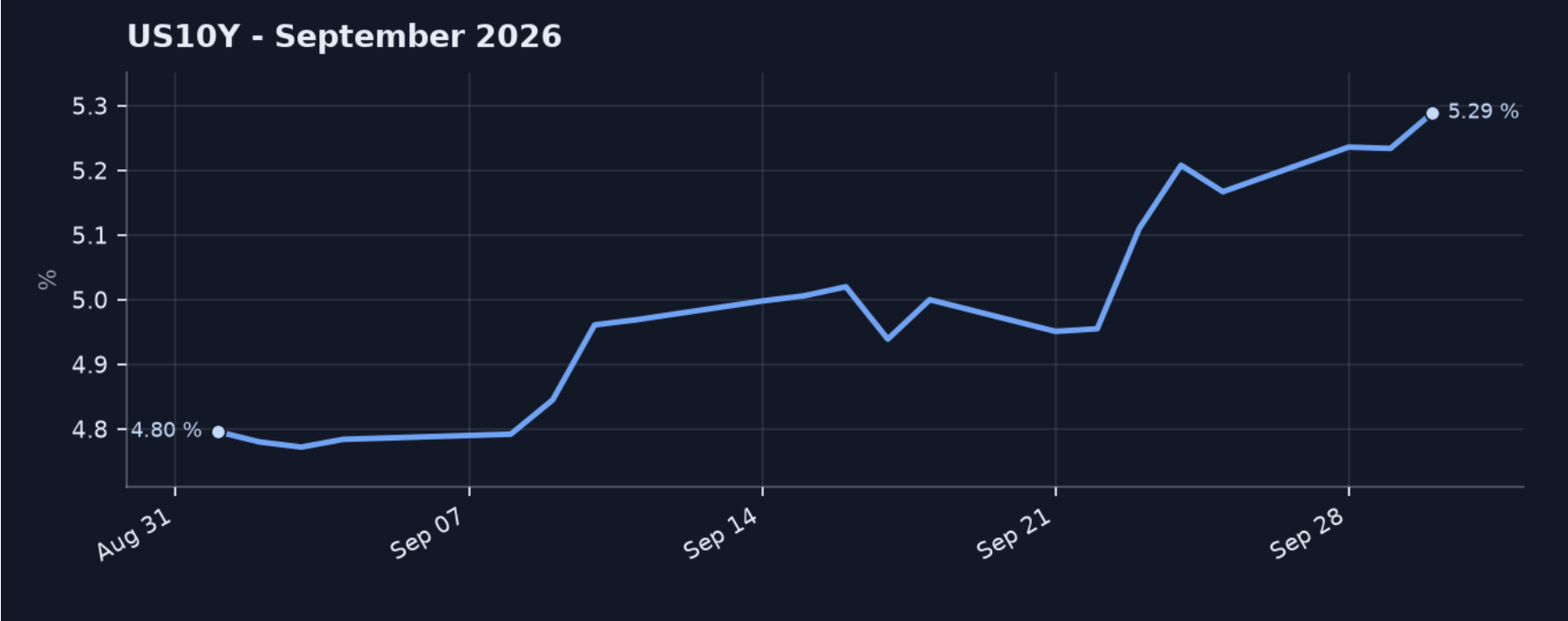
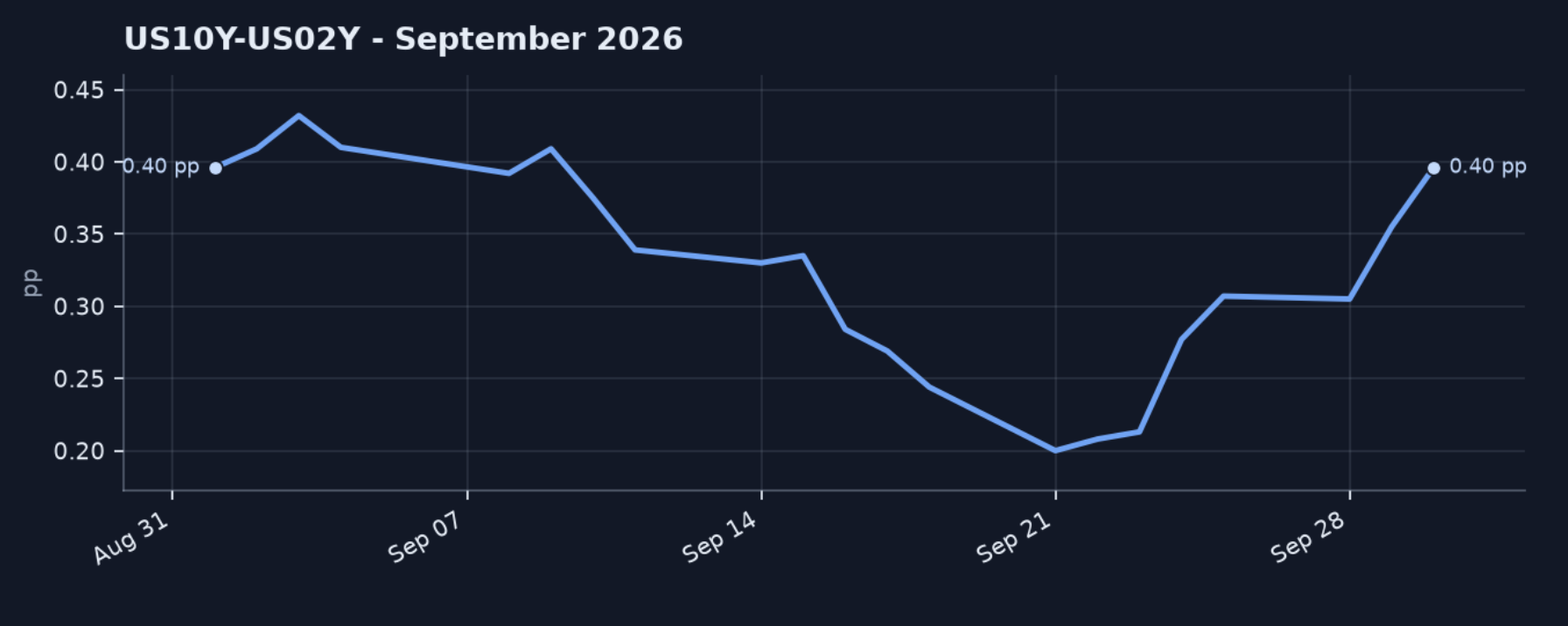
Bonds had a difficult month. The Bloomberg U.S. Aggregate (-2.61%) and the Global Aggregate (-2.38%) both fell as yields rose around the world. The 10-year Treasury yield climbed from 4.75% at the end of August to 5.29%, and the 2-year rose by a similar amount, so the gap between them ended close to where it began. The path mattered more than the endpoint. Through September 21 short-term yields rose faster, as inflation data and the Fed's increase lifted near-term rate expectations, and the gap between 10-year and 2-year yields narrowed from +0.41 percentage points (pp) to +0.20pp. From September 23 long-term yields rose faster, and the gap widened back to +0.40pp by month-end. Credit spreads, calm for most of the month, widened late: the extra yield on high-yield bonds rose from 263 to 312 basis points (a basis point is one-hundredth of a percentage point), most of it after September 23, leaving spreads at their widest since early April but still below the March peak. Separately, on September 30 the Bureau of Economic Analysis (BEA) published its annual revision. It raised second-quarter growth to 2.2% from 1.5%. It also lowered July headline inflation on the PCE price index, the Fed's preferred measure, to 3.3% from a first-reported 3.7%. On the revised figures, August PCE inflation was 3.4%, and 3.0% excluding food and energy ("core"), both still well above the Fed's 2% objective.
- Bloomberg US Aggregate -2.61%, Global Aggregate -2.38%.
- The 10-year rose from 4.75% at the end of August to 5.29%, its highest close since May 2002, and the gap between 10-year and 2-year yields ended at +0.40pp (percentage points) after shrinking to +0.20pp on September 21.
- Takeaway: Bonds lost money in September as strong growth and hot inflation pushed yields up by more than half a percentage point, a move that hurts longer maturities most. Higher yields also mean bonds now pay more income.
Commodities: oil up on the war, gold down on rates
Oil rose 7.90% on a supply shock tied to the conflict with Iran. Two supertankers were struck leaving the Strait of Hormuz on September 1, U.S. forces struck Iranian tankers on September 5, and OPEC+, the group of major oil-producing countries, paused its production increases on September 6. On September 11 the International Energy Agency said more than 10 million barrels a day of Gulf output was still offline and pushed its expected return to normal into 2027. Prices swung in the second half. Brent, the international oil benchmark, fell for 5 straight trading days into September 22 as talks with Iran on the sidelines of the U.N. General Assembly raised hopes. It climbed again after a Houthi strike on Saudi Arabia on September 24 and President Trump's rejection of Iran's proposal to reopen the strait on September 26. It then eased on September 29 as Gulf exports recovered.
Gold (-6.75%) fell as yields and the dollar rose, and much of the loss came in a single 3.3% drop on September 28. Copper set record highs on the Comex exchange in New York during the month and finished September up 1.07%. Bitcoin, measured by the iShares Bitcoin Trust (IBIT), rose 5.98%, with U.S. bitcoin funds taking in close to $1 billion on September 21, their largest single day of inflows this year.
- WTI crude +7.90%; S&P GSCI Copper +1.07%.
- Gold -6.75%; US Dollar +2.03%; Bitcoin (IBIT) +5.98%.
- Takeaway: The war in the Middle East pushed oil higher and kept energy costs feeding into inflation that was already running hot, while higher interest rates and a stronger dollar pulled gold down sharply. Energy stocks fell 2.72% even as oil rose 7.90%, a reminder that commodity prices and the companies that produce them can move apart.
Key dates to watch in October 2026
Growth
- Oct 1: ISM Manufacturing PMI (survey of factory activity).
- Oct 2: Nonfarm payrolls (monthly jobs report), unemployment rate.
- Oct 5: ISM Non-Manufacturing PMI (survey of service businesses).
- Oct 15: Retail sales.
Inflation
- Oct 14: CPI, core CPI.
Financial conditions
- Oct 7: FOMC meeting minutes (record of the Fed's September meeting).
- Oct 28: Fed interest rate decision.
The bottom line
September was the month higher interest rates spread across markets. The backdrop barely changed: growth stayed strong, inflation stayed hot, and broad financial conditions were still looser than average, with a war in the Middle East keeping energy prices high. What changed is the cost of borrowing. The Fed has now started raising rates again, and officials' median projection calls for 1 more increase this year. With the 10-year Treasury yield ending the month above 5%, bonds compete harder for investors' money, so stocks and other riskier investments need to offer more before investors choose them over bonds. Inflation is still well above the Fed's 2% objective. The things to watch in October are September's CPI on October 14, the Fed's October 28 decision, and whether the late widening in credit spreads continues, because that would show higher rates starting to strain borrowers.


Anshul Sharma is Chief Investment Officer at Savvy Wealth, where he oversees the firm’s investment strategy, portfolio design, and platform innovation. He partners across product, marketing, and operations teams to deliver portfolios that take a methodological approach to balance customization with scalability for advisors and their clients. Before joining Savvy, Anshul spent nearly two decades at Bank of America, where he managed the Chief Investment Office’s Sustainable Model Portfolio Suite, launched new proprietary offerings, and, as Head of Alternative Investment Strategy, provided guidance and thought leadership to advisors around hedge fund, private market, and real asset strategies. He began his career as an Investment Strategist at U.S. Trust, designing multi-asset portfolios for high-net-worth and institutional clients. Anshul holds a Master of Financial Engineering from UC Berkeley and a Bachelor of Computer Engineering from Lehigh University. Outside of work, he is an avid tennis player, enjoys time with his wife, two sons, and their Bernedoodle, and is an auto enthusiast who loves cooking and travel.

Ani Vedere is a Senior Research Analyst at Savvy Wealth, where he works across macro research, portfolio construction, and investment technology. He partners closely with the Chief Investment Officer and cross-functional teams spanning product, engineering, and design to develop scalable investment solutions, advisor-facing tools, and research workflows that help advisors deliver better outcomes for clients. Prior to joining Savvy, Ani was an Investment Analyst at a registered investment advisor, where he managed model portfolio implementation across hundreds of client accounts and built automated research and portfolio monitoring systems using Python and AI. Before that, he spent four years at a discretionary global macro hedge fund conducting multi-asset research, developing systematic investment frameworks, and building analytics to support portfolio management and trading decisions. Ani holds a Bachelor of Science in Finance from the University of Connecticut. Outside of work, he enjoys spending time outdoors, watching movies (in theatres!), reading, and writing. Fair warning: ask him about markets or macroeconomics, and you may end up in a much longer conversation than you planned.
Material prepared herein has been created for informational purposes only and should not be considered investment advice or a recommendation from the Savvy Investment Team. Information was obtained from sources believed to be reliable but was not verified for accuracy.
Savvy Wealth Investment Management (“SWIM”) is a proprietary, in-house investment solution offered by Savvy Advisors, Inc. (“Savvy Advisors”). It is designed to support financial advisors in the management of client portfolios. Savvy Wealth Investment Management is not a separate legal entity and is not independently registered as an investment adviser. All advisory services are provided by Savvy Advisors in its capacity as a registered investment adviser.