



401(k) Rollover Mistakes: What You Give Up When You Move the Money to an IRA

Completing a 401(k) rollover takes only about 10 minutes of paperwork, but transferring those assets to an IRA is usually an irreversible decision. When you move the money, you’re giving up three built-in plan provisions: penalty-free access at age 55, broad creditor protection outside bankruptcy, and favorable tax treatment on appreciated employer stock. For investors with substantial account balances, these losses could carry some financial weight.
Key Takeaways
Here are some points that we’ll cover in the article:
- Three key benefits are surrendered: Moving funds to an IRA removes Rule of 55 early access, broad non-bankruptcy creditor protection, and net unrealized appreciation (NUA) tax treatment on employer stock.
- Losses are permanent: Once completed, you generally can’t reverse an IRA rollover to reclaim these specific features.
- Mechanical errors are avoidable: Tax withholding and 60-day window traps stem from execution errors, not structural loss.
- The correct path varies: Your optimal choice depends on your age, asset types, and liquidity needs.
The Decision Most People Make in Ten Minutes
Financial institutions often frame a rollover as routine administrative paperwork when changing jobs. In reality, moving funds out of an employer plan is one of the few genuinely irreversible decisions in retirement planning. Once completed, you can’t undo the transfer to recover lost benefits.
Your Four Options, and Why “Roll to an IRA” is the Default
When leaving an employer, you typically have four choices: leave the money in your old plan, transfer it to a new plan, roll it into an IRA, or cash out. For further information, you can review our article “What Happens to Your 401(k) When You Leave a Job.”
If you’re asking yourself, “Should I rollover my 401(k),” an IRA is generally recommended for broader investments and consolidation. However, institutions publishing rollover guidance typically hold receiving accounts and earn fees on managed assets. As a result, investors seldom hear the case against rolling over. Here is that case.
Loss #1: Penalty-Free Access at 55
For anyone planning to stop working in their mid-to-late fifties, surrendering early access is often the most expensive loss and the least understood.
How the Rule of 55 Works
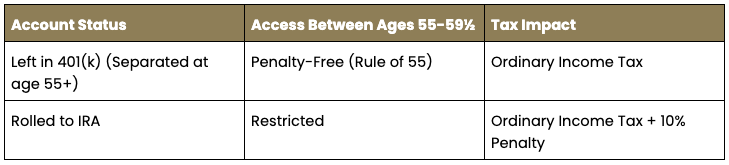
Under federal tax rules, if you separate from service after reaching age 55, you might take distributions from that employer’s plan without the 10% additional tax.
Furthermore, income tax still applies, and the rule covers only the plan of the employer you separated from. Crucially, the Rule of 55 does not apply to IRAs, SEPs, or SIMPLE IRAs. Public safety employees may also qualify at age 50 under governmental plans.
What Rolling to an IRA Costs You, and Who Should Care Most
Moving assets to an IRA permanently eliminates this exception, resetting penalty-free access to age 59½. An individual separating at age 56 who rolls everything over creates a multi-year liquidity gap, in which tapping those funds triggers a 10% penalty.
To bridge the gap, you need to draw from taxable accounts or incur the penalty. If the plan allows it, a partial rollover can mitigate this risk by leaving enough money in the plan for intermediate spending.
This is crucial if you’re looking to retire early, accept severance in your fifties, or hold most savings inside qualified plans rather than taxable accounts. Anyone pursuing early retirement planning or structuring a three-bucket retirement strategy should evaluate this tradeoff carefully, whereas a 40-year-old can usually set it aside.
Loss #2: Creditor Protection Outside Bankruptcy
The legal protection gap between plans and IRAs is narrower than often claimed, centered outside bankruptcy rather than within it.
Where the Protection Actually Differs, and Who It Matters To
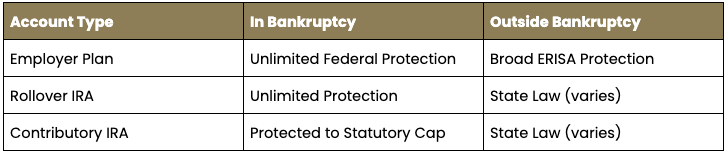
In bankruptcy, employer plan balances carry unlimited protection. Funds rolled into an IRA retain this unlimited defense, as rollover dollars do not count toward the statutory cap on contributory IRAs.
Outside bankruptcy, protections diverge. Qualified employer plans enjoy broader federal ERISA anti-alienation shielding. IRA protections rely on varying state laws.
Commingling rollover dollars with standard IRA contributions can also complicate asset tracing in court. As such, keeping rolled funds in a dedicated conduit IRA can preserve their distinct status.
This variance is important to medical professionals, business owners with personal guarantees, or those with active litigation risks. You can always consult an attorney regarding specific legal protections if you’re unsure of anything.
Loss #3: Favorable Treatment on Appreciated Employer Stock
This mistake often carries the largest financial penalty and is spotted least frequently. It applies specifically when company stock is held in your plan. Once funds move to an IRA, this tax treatment is lost for good.
What Net Unrealized Appreciation Is
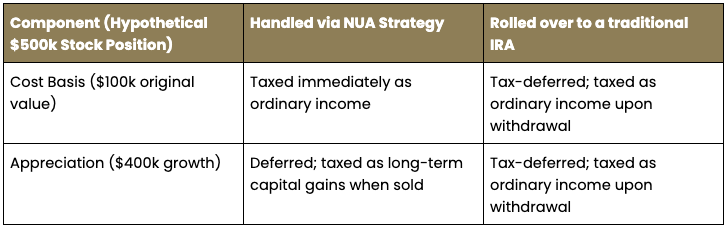
If employer stock inside your plan has grown substantially, a tax strategy known as Net Unrealized Appreciation (NUA) lets you pay ordinary income tax only on the original cost basis of the shares. The growth above that basis is taxed at long-term capital gains rates when you eventually sell.
To qualify for NUA, employer stock must be distributed in-kind rather than rolled over, following a triggering event such as separation from service, age 59½, disability, or death.
Crucially, the transfer requires a full lump-sum distribution, meaning you must clear the entire balance across all qualified plans with that employer within a single tax year. Cost basis represents the original value of the securities when contributed to the plan. Rolling company stock into an IRA destroys this distinction, converting all future withdrawals into ordinary income.
When This Strategy is Worth Using
NUA works best when the cost basis is low relative to the current market value. It’s generally less attractive if the basis is high, the holding period is short, or you plan to sell the shares immediately. Using NUA requires paying ordinary income tax upfront on the cost basis in the year of distribution.
The 10% early withdrawal penalty applies only to the cost basis if distributed before age 59½. Separating from service during or after the year you turn 55 provides an exception, allowing an NUA distribution without a penalty applying to the cost basis.
Coordinating this one-time election requires support from advisors and CPAs through tax planning and optimization services, such as Savvy Tax. Corporate executives, including those evaluating tax planning for P&G employees, should evaluate this option before initiating plan transfers.
What to Do With the Shares Afterward
Executing NUA shifts the primary challenge from tax drag to position concentration. You now hold a large, low-basis stock position in a single company outside a tax-deferred account.
Also, rather than selling all shares at once, you can implement a plan to reduce a concentrated stock position over time. Furthermore, features like Savvy Direct Indexing let you transfer low-basis shares into portfolios using direct indexing with tax-loss harvesting to manage capital gains gradually.
The Mechanical Mistakes, Handled Quickly
Most internet rollover guides lead with administrative errors. While these execution traps carry severe tax penalties, they remain straightforward to avoid. You can avoid many execution errors with a single instruction to your plan administrator.
Direct vs. Indirect, and the 20% That Disappears
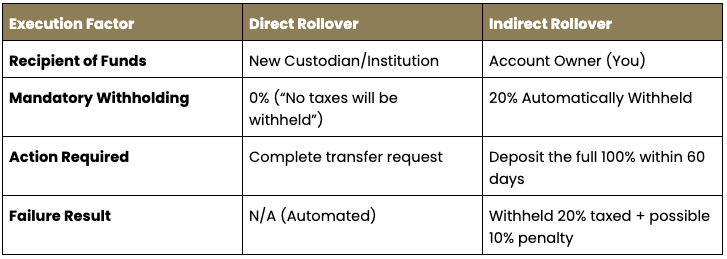
Understanding a direct rollover vs. an indirect rollover ensures you avoid unintended tax bills. The IRS dictates that, “a retirement plan distribution paid to you is subject to mandatory withholding of 20%, even if you intend to roll it over later.”
If you redeposit only the check you received, the withheld 20% becomes taxable income and may face a 10% early withdrawal penalty. The IRS also notes, “If you later roll the distribution over within 60 days, you must use other funds to make up for the amount withheld.”
Conversely, with a direct transfer, “no taxes will be withheld from your transfer amount.” Instruct your administrator to issue a direct trustee-to-trustee transfer payable to your new institution.
The 60-Day Clock and Cashing Out
The IRS enforces a strict 60-day rollover rule: “You have 60 days from the date you receive an IRA or retirement plan distribution to roll it over to another plan or IRA.”
Importantly, the once-per-12-months limit applies solely to indirect IRA-to-IRA rollovers. It does not limit transfers from workplace plans to IRA or direct trustee-to-trustee transfers, which the IRS notes, are never paid or distributed to the IRA owner.
Also, cashing out triggers full income taxes, early withdrawal penalties under age 59½, and permanent loss of tax-advantaged growth. While genuine financial emergencies occur, cashing out is the most costly way to liquidate.
So Should You Roll It Over?
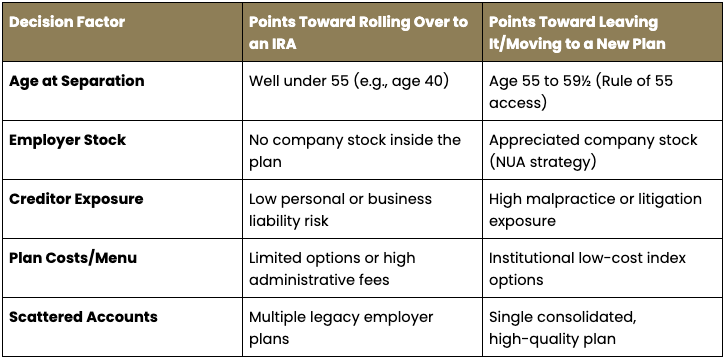
Deciding whether to roll over your 401(k) requires balancing account flexibility against the loss of plan protections. The decision comes down to your age, asset composition, and individual exposure risks.
When Each Path Makes Sense
Rolling over makes sense if you’re well under age 55, hold no employer stock, face low liability risk, and want to consolidate scattered old accounts into a single view via tools like the Savvy Dashboard. It expands investment choices, unlocks flexible beneficiary setups, and allows Roth conversion strategies. You can evaluate these options by reviewing how IRAs and 401(k)s compare and weighing a Roth 401(k) versus traditional plan setup.
One Question to Ask Whoever is Advising You
A lot of rollover advice comes from institutions that hold receiving accounts or earn management fees. Financial advisors compensated on assets under management typically earn higher fees when money moves into accounts they oversee rather than remaining in employer plans.
Before initiating any transfer, ask your advisor (including us) to document in writing why moving your funds serves your interest better than keeping them in your employer plan.
Conclusion
Deciding if you should roll over a 401(k) demands far more than completing standard administrative forms. Before transferring assets out of an employer plan, take four critical evaluation steps:
- Verify company stock holdings: Check if employer stock sits inside your account and identify its original cost basis.
- Review your separation age: Confirm your exact age at separation relative to the Rule of 55 early access threshold.
- Compare total plan costs: Audit your old plan’s administrative fees and investment options against potential IRA expenses.
- Demand written clarity: Require your advisor to document in writing why a rollover serves your interest better than keeping funds in your plan.
Speak with a Savvy Wealth fiduciary advisor before you move retirement assets you can’t move back.
Frequently Asked Questions
What are the disadvantages of a 401(k) rollover?
Rolling over can eliminate Rule of 55 early access at age 55, broad federal ERISA creditor protection outside bankruptcy, and favorable net unrealized appreciation (NUA) long-term capital gains tax treatment on appreciated employer stock.
How do I avoid 401(k) rollover mistakes?
Request a direct trustee-to-trustee transfer payable to your new account custodian. This step avoids mandatory 20% tax withholding, circumvents 60-day redeposit deadlines, and prevents accidental taxable early distribution penalties.
How can I roll over my 401(k) without penalty?
Execute a direct trustee-to-trustee transfer into a traditional IRA or eligible employer plan. Moving assets directly between qualified custodians preserves tax-deferred status and avoids early withdrawal penalties regardless of your age.
What happens if I don't roll over my 401(k)?
Your assets remain in your former employer's plan, growing tax-deferred under ERISA creditor protections. Depending on plan balance requirements, you can generally leave the funds indefinitely, transfer them later, or move them to a new employer's plan.
How many times a year can you do a 401(k) rollover?
There is no annual limit on moving funds directly from a 401(k) to an IRA via trustee-to-trustee transfers. The IRS once-per-12-months rollover restriction applies strictly to indirect, account-owner-mediated IRA-to-IRA transfers.
Is it better to withdraw or roll over a 401(k)?
Rolling over is generally far superior to cashing out. Withdrawing triggers immediate income taxes, forfeits future tax-deferred growth, and typically incurs a 10% early withdrawal penalty if executed prior to reaching age 59½.
Why can't I roll over my 401(k) while still employed?
Active employer plans usually restrict distributions while you remain employed. However, some plans allow in-service withdrawals once you reach age 59½ or meet specific hardship and plan-defined criteria.


Quintin Sharpe is a dedicated Wealth Manager based in Fontana, WI. A University of Wisconsin-Whitewater graduate with a BBA in Finance, and a Financial Planning emphasis, Quintin started as a client service specialist at Ameriprise Financial before advancing from financial representative to advisor at Northwestern Mutual.

Works Cited
- Topic no. 558, Additional tax on early distributions from retirement plans other than IRAs
- Retirement topics - Exceptions to tax on early distributions
- Why The Net Unrealized Appreciation (NUA) Rules Aren’t Always A Great Deal
- Rollovers of retirement plan and IRA distributions