



Oil, yields, and a widening rotation
July's decline at the index level masked something more constructive underneath: a rotation, not a retreat from risk. The backdrop that matters for portfolios stayed intact, and in our framework it was distinctly reflationary: nominal growth firm and firming through the month (real activity positive, inflation still hot near 3.7%), with financial conditions easy (the Chicago Fed's NFCI sat around -0.55) and little sign of market stress. What changed was the price of duration. A roughly 23% jump in WTI crude and a climb in the 10-year Treasury yield from 4.46% to roughly 4.72% pushed markets to price a more hawkish Fed: expectations for about 1.7 hikes into December 2026 and 1.8 through 2027, up sharply from just under one hike through 2027 in early July. Higher discount rates fall hardest on the longest-duration cash flows, so the mega-cap growth leaders bore the brunt: the Nasdaq fell 3.19% and the S&P 500 finished essentially flat (-0.06%), while the equal-weight S&P 500 rose 1.01% and energy (+12.60%), financials (+6.16%), and real estate (+2.52%) led. The takeaway: firm nominal growth and easy conditions kept the economy and risk appetite intact, even as rising rates and an uncertain inflation path re-rated who leads.
- A rotation, not a risk-off. The S&P 500 finished essentially flat (-0.06%) and the Nasdaq fell -3.19%, but the equal-weight S&P 500 rose +1.01% and breadth improved: the weakness was concentrated in the priciest, longest-duration growers, not the broad market.
- Growth derated, leadership rotated. S&P 500 -0.06%, Nasdaq -3.19%; Russell 2000 -3.03%, S&P Equal-Weight +1.01%. Energy +12.60%, Financials +6.16% led; Information Technology -3.43%, Industrials -3.01% lagged.
- Oil surged. WTI +22.61% on the month, a fresh energy-price shock that reignited headline-inflation concerns and helped drive the hawkish repricing in rates.
- Firm growth and easy money underneath. Nominal growth stayed firm and financial conditions stayed accommodative (NFCI ~-0.55); Bitcoin (IBIT) +7.06% and Gold +0.86% both gained and credit stress stayed low, none of which is the signature of a risk-off.
- Bonds fell with yields. Bloomberg US Aggregate -1.30%, Global Aggregate -0.53%. This time the long end moved too, so high-quality duration offered little shelter.
Noteworthy developments
Rotation, not risk-off
The dominant story of July was rotation, not a broad flight from risk. Three things show the economy and risk appetite held up even as the index slipped. First, breadth improved: the average stock (equal-weight S&P +1.01%) beat the cap-weighted index (-0.06%) as the market's narrow concentration in a handful of giants unwound. Second, financial conditions stayed easy and credit stress stayed low, so this was not a liquidity or solvency scare. Third, the weakness was concentrated in mega-cap technology (the Nasdaq -3.19%, Information Technology -3.43%), while firm nominal growth kept cyclicals and value (energy, financials, real estate) bid. When the discount rate rises against a backdrop of solid nominal growth, leadership re-rates without the cycle turning. That is the constructive reading, and it is the one our own macro framework carried all month: a reflationary regime (firm, improving growth; still-easy financial conditions; hot inflation) that favored real assets and cyclicals over long-duration growth. Markets delivered almost exactly that map: commodities and other alternatives led, bonds lagged, the dollar softened rather than catching a haven bid, and equities stayed supported underneath even as the headline index slipped.
U.S. equities — index down, breadth up: the rotation out of mega-cap growth deepens
U.S. equities finished July with a split tape: the cap-weighted indexes were flat to lower, but participation underneath improved. The S&P 500 slipped -0.06% and the Nasdaq -3.19% as rising yields and firmer oil repriced long-duration growth, while the equal-weight S&P 500 rose +1.01%, a clear sign the month's weakness was concentrated in a handful of mega-cap leaders rather than a broad retreat from risk. Small caps were an exception: the Russell 2000 fell -3.03%, held back by higher rates.
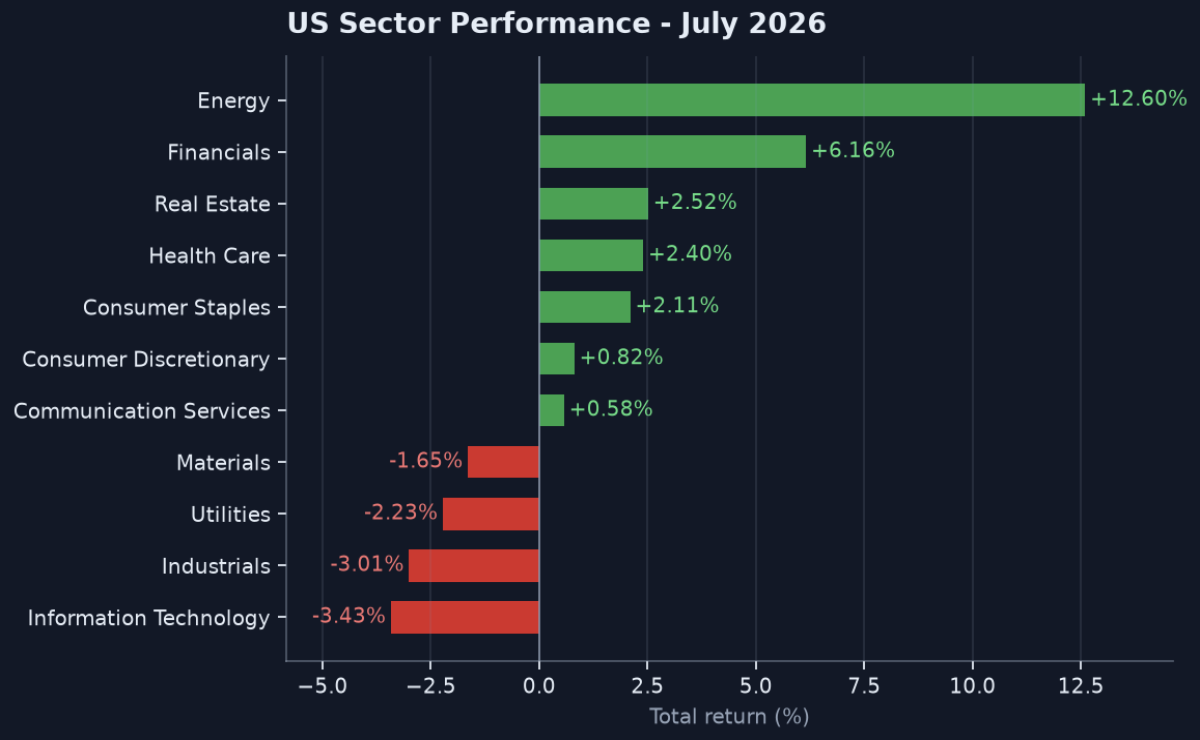
Sector leadership told the rotation story cleanly. Energy (+12.60%) led on the oil surge, followed by Financials (+6.16%) and Real Estate (+2.52%), with defensives Health Care (+2.40%) and Consumer Staples (+2.11%) also higher. The clear laggards were mega-cap technology and rate-sensitive cyclicals: Information Technology (-3.43%), Industrials (-3.01%), and Utilities (-2.23%) absorbed most of the hawkish repricing, exactly where a rising discount rate bites hardest.
The headline index barely moved, but breadth improved underneath. That is the profile of a rotation, a re-rating of leadership and valuations as oil and yields rose, rather than a growth scare about the underlying economy.
- Indices (July): S&P 500 -0.06% · Nasdaq Composite -3.19% · Russell 2000 -3.03% · S&P 500 Equal-Weight +1.01%.
- Sector leaders: Energy +12.60%, Financials +6.16%, Real Estate +2.52%, Health Care +2.40%, Consumer Staples +2.11%, Consumer Discretionary +0.82%.
- Sector laggards: Information Technology -3.43%, Industrials -3.01%, Utilities -2.23%, Materials -1.65%.
- Takeaway: The market was flat at the index level but got broader underneath, which is what a rotation looks like rather than a sell-off. Money moved out of a handful of pricey, rate-sensitive tech names and into energy, banks, and real estate.

International markets — mixed, with commodity markets up and tech-heavy Asia down
International equities were uneven in July, split along the same reflation line as the U.S. tape. Commodity- and energy-linked markets did well, while technology- and semiconductor-heavy Asia was hit hard. MSCI EAFE returned +1.97% and emerging markets -3.03%.
China (+9.04%) led the major markets, and commodity exporters Canada (+2.87%) and Australia (+4.57%) benefited from firmer energy and metals; Mexico (+1.98%) and Germany (+3.19%) also finished higher. The pain was concentrated in tech-heavy Asia: Korea (-17.11%) was the month's worst major market by a wide margin, with Taiwan (-5.29%) and the broad emerging-market index (-3.03%) also lower as the global semiconductor complex de-rated. Japan (+1.03%) and India (+1.78%) finished modestly higher.
For internationally diversified portfolios, July was a reminder that the same force driving U.S. sector leadership, a rotation out of expensive technology and toward commodities and cyclicals, plays out across borders too.
- Up: China +9.04%, Australia +4.57%, Germany +3.19%, Canada +2.87%, Mexico +1.98%, EAFE +1.97%, India +1.78%, Japan +1.03%.
- Down: Emerging Markets -3.03%, Taiwan -5.29%, Korea -17.11%.
- Takeaway: International markets split along the same line as the U.S. Commodity-linked markets like China, Canada, and Australia rose, while tech-heavy Korea and Taiwan fell sharply as semiconductors sold off.

Fixed income — yields rose across the curve; duration offered little cover
Fixed income lost ground in July as yields rose. The Bloomberg U.S. Aggregate Index returned -1.30% and the Global Aggregate -0.53%: a reminder that when the whole curve reprices higher, high-quality duration does not shelter a portfolio the way it does in a growth scare. That is what a reflationary regime implies, with firm growth and hot inflation pointing away from bonds, and July delivered it.
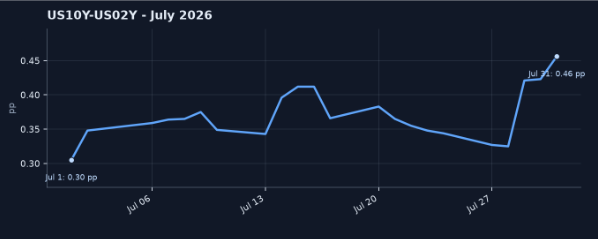
The move was broad-based. The 10-year Treasury yield climbed from 4.46% to roughly 4.72% over the month, as the oil surge and sticky inflation pushed investors to price a more hawkish Fed. The 2s10s curve steepened to about +0.46pp. Unlike June, when the front end did most of the work, July saw long-term rates move too, a genuine if contained bond selloff.
On the income side, the month reinforced the 'hold to earn, don't extend' message: with yields elevated and the Fed leaning hawkish, bonds still pay a healthy coupon, but adding duration here carries meaningful price risk.
- Bloomberg US Aggregate -1.30%, Global Aggregate -0.53%.
- The 10-year rose to ~4.72% from 4.46% at the start of the month, with 2s10s ~+0.46pp; yields rose across the curve.
- Takeaway: Bond prices slipped as interest rates rose across the board, so this month high-quality bonds didn't cushion the portfolio, though they now pay a healthier yield.

Commodities — oil surges as the reflation trade reignites
Commodities were the epicenter of July's move. A sharp rally in crude oil reset the inflation conversation, lifted energy equities, and helped push up the yields that pressured long-duration growth stocks.
WTI crude jumped 22.61%, the month's single most important cross-asset move, reintroducing an energy-price premium that markets had drained in June. Copper (+3.62%) rose alongside it, a sign global industrial demand is holding in and consistent with firm nominal growth. Gold (+0.86%) and Bitcoin (+7.06%) both advanced as well, with gold acting as an inflation hedge; the dollar fell (-1.37%), so this was a move in risk appetite up, not a flight to safety. It also fits our regime read, which favored real assets and other alternatives all month: our highest-conviction cross-asset call, and the one that led.
In plain terms: the jump in oil is a headwind for gasoline prices and headline inflation, and it is a large part of why the market spent July bracing for a firmer Fed.
- WTI crude +22.61%; S&P GSCI Copper +3.62%.
- Gold +0.86% (inflation-hedge bid even with real yields higher and the dollar lower).
- Cross-asset context: US Dollar -1.37% and Bitcoin +7.06%.
- Takeaway: Oil surged roughly 23%, pushing up gas prices and clouding the inflation outlook, while gold and Bitcoin also rose and the dollar fell, a sign investors were rotating rather than fleeing risk.

Key dates to watch in August 2026
Growth
- Aug 3: ISM Manufacturing PMI.
- Aug 5: ISM Non-Manufacturing PMI.
- Aug 7: Nonfarm Payrolls, Unemployment Rate.
- Aug 14: Retail Sales.
Inflation
- Aug 12: CPI, Core CPI.
The bottom line
July was a rotation, not a retreat: the market behavior of a reflationary regime, not a risk-off. Firm nominal growth and still-easy financial conditions kept the economy and risk appetite intact, while a roughly 23% surge in oil and a climb in the 10-year yield toward 4.72% pushed markets to price a firmer Fed (about 1.7 hikes into December 2026). Higher discount rates hit the long-duration growth leaders hardest (Nasdaq -3.19%, with the S&P 500 roughly flat at -0.06%), but breadth improved and energy, financials, and real estate led, with the equal-weight S&P 500 higher on the month. The market's tolerance for inflation or earnings disappointment has narrowed. We remain constructive on the economy, observing the rotation in leadership, and watching the Fed and oil from here.



Anshul Sharma is Chief Investment Officer at Savvy Wealth, where he oversees the firm’s investment strategy, portfolio design, and platform innovation. He partners across product, marketing, and operations teams to deliver portfolios that take a methodological approach to balance customization with scalability for advisors and their clients. Before joining Savvy, Anshul spent nearly two decades at Bank of America, where he managed the Chief Investment Office’s Sustainable Model Portfolio Suite, launched new proprietary offerings, and, as Head of Alternative Investment Strategy, provided guidance and thought leadership to advisors around hedge fund, private market, and real asset strategies. He began his career as an Investment Strategist at U.S. Trust, designing multi-asset portfolios for high-net-worth and institutional clients. Anshul holds a Master of Financial Engineering from UC Berkeley and a Bachelor of Computer Engineering from Lehigh University. Outside of work, he is an avid tennis player, enjoys time with his wife, two sons, and their Bernedoodle, and is an auto enthusiast who loves cooking and travel.

Ani Vedere is a Senior Research Analyst at Savvy Wealth, where he works across macro research, portfolio construction, and investment technology. He partners closely with the Chief Investment Officer and cross-functional teams spanning product, engineering, and design to develop scalable investment solutions, advisor-facing tools, and research workflows that help advisors deliver better outcomes for clients. Prior to joining Savvy, Ani was an Investment Analyst at a registered investment advisor, where he managed model portfolio implementation across hundreds of client accounts and built automated research and portfolio monitoring systems using Python and AI. Before that, he spent four years at a discretionary global macro hedge fund conducting multi-asset research, developing systematic investment frameworks, and building analytics to support portfolio management and trading decisions. Ani holds a Bachelor of Science in Finance from the University of Connecticut. Outside of work, he enjoys spending time outdoors, watching movies (in theatres!), reading, and writing. Fair warning: ask him about markets or macroeconomics, and you may end up in a much longer conversation than you planned.
Material prepared herein has been created for informational purposes only and should not be considered investment advice or a recommendation from the Savvy Investment Team. Information was obtained from sources believed to be reliable but was not verified for accuracy.
Savvy Wealth Investment Management ("SWIM") is a proprietary, in-house investment solution offered by Savvy Advisors, Inc. (“Savvy Advisors”). It is designed to support financial advisors in the management of client portfolios. Savvy Wealth Investment Management is not a separate legal entity and is not independently registered as an investment adviser. All advisory services are provided by Savvy Advisors in its capacity as a registered investment adviser.