
What Higher Interest Rates Mean for Your Portfolio

What a Fed hike does to stocks and bonds, and what to watch
In brief
The Fed is raising rates again. What does that do to a portfolio, and should anything change? Expect a bumpier few months, not a crash. A rate rise lowers what every future dollar is worth today, so prices fall before earnings can catch up. A first hike after cuts tells investors that rates have turned. Prices adjust within weeks, and earnings take months to respond. Since 1982, six of seven first hikes (86%) were followed by a stock fall of 5% or more within three months. That happens in 30% of three-month stretches anyway. Today, two of three growth gauges are rising with rates, the kind of rise stocks have absorbed.
Five things to know
A higher rate lowers what future dollars are worth.
Cash in hand can earn interest, so money due later is worth less today when rates are higher.

Bonds feel it first.
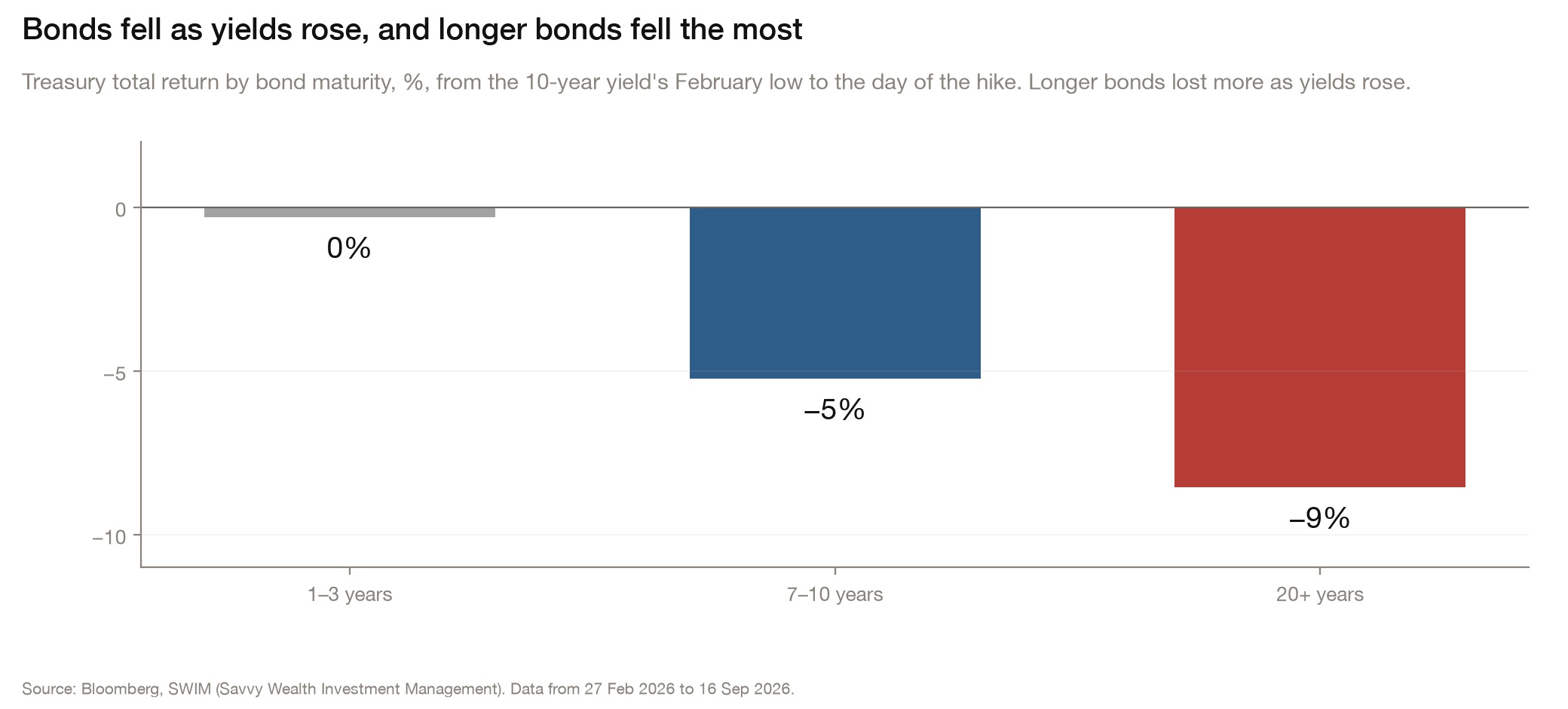
A bond's payments are fixed, so when new bonds pay more, its price must fall. Longer bonds have more payments to mark down.
Expect a dip.
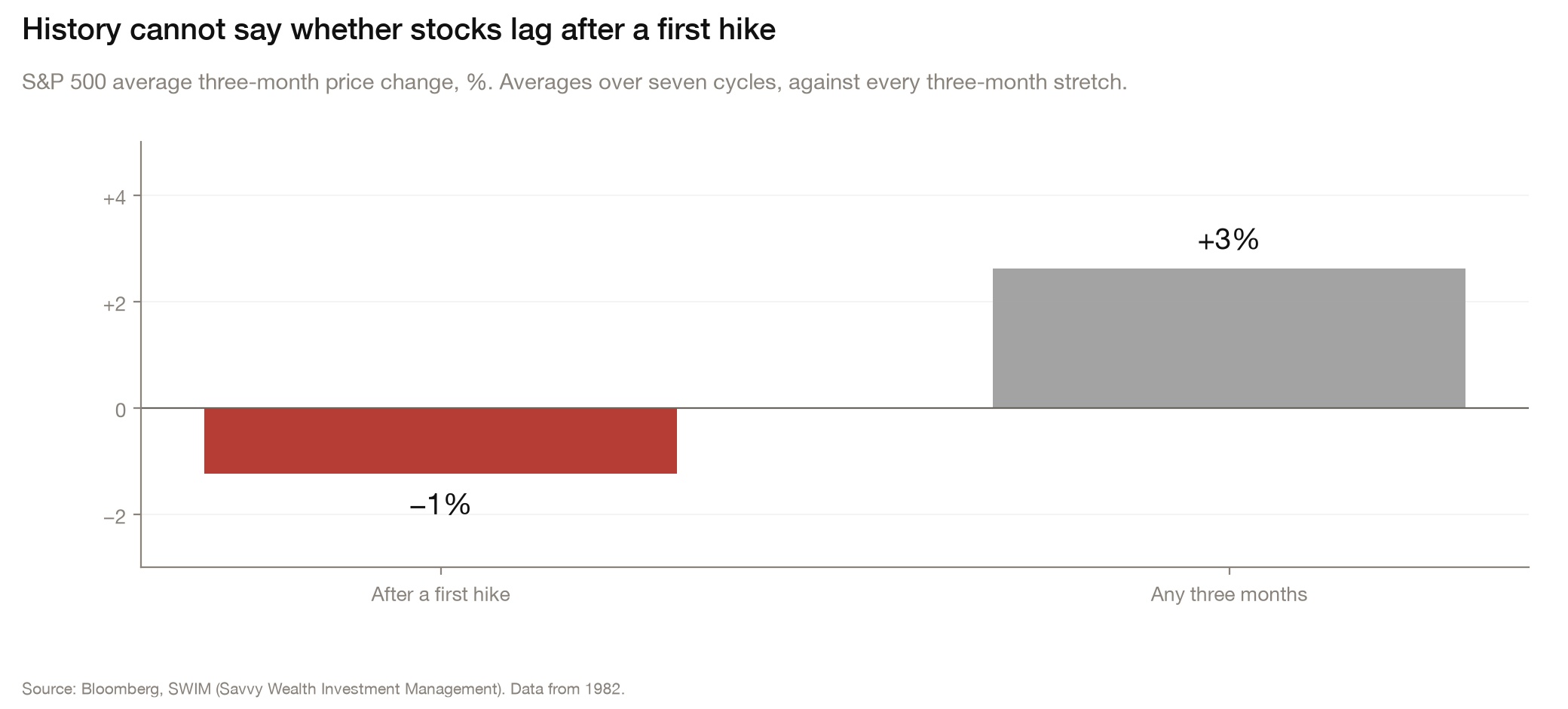
Most stock falls after a first rate hike were ordinary pullbacks, not crashes.


How fast it passes is unknown.
History cannot tell us how quickly a dip like this passes. Seven cycles are too few to know.
Watch growth.
Since 2003, stocks gained on average when the growth gauges rose with yields, and fell when the gauges did not.

Get the client-ready deck, a plain-language version of this piece built for advisors to share with clients.
.blog-cta-btn{margin:1.5rem 0 2.5rem}.blog-cta-btn a.v2-button{display:inline-block;padding:1.4rem 2rem;border-radius:5px;background-color:var(--_v2-color-system---base-color-primary--gold);color:var(--_v2-color-system---base-color-primary--white);font-size:1.125rem;font-weight:500;line-height:100%;text-align:center;text-decoration:none}.blog-cta-btn a.v2-button:hover{background-color:#a09068;color:var(--_v2-color-system---base-color-primary--white);text-decoration:none}Download the client deck
Why higher rates mark prices down
$100 due in ten years is worth about $68 today at 4% interest and about $61 at 5%. Bonds fell as yields rose, and longer bonds fell the most. From February to the hike, the 10-year yield rose from 3.94% to 5.02%. Treasuries maturing in seven to ten years lost about 5%, and over twenty years about 9%. A strong economy grows company earnings, which can offset higher rates.
What the record shows
The median worst fall after a first hike was 7%. Only two of the seven cycles saw a fall of 10% or more, against 12% of stretches from any day. Over the next three months, stocks averaged −1% after first hikes and 3% from any day. Seven cycles cannot tell either gap from chance. Telling them apart would take about 264 years of history.
What decides what comes next
Since 2003, when inflation-adjusted yields rose with the growth gauges, stocks gained about 2% over three months. When gauges lagged, they lost about 3%. That is a pattern from the past, not a law.
Today
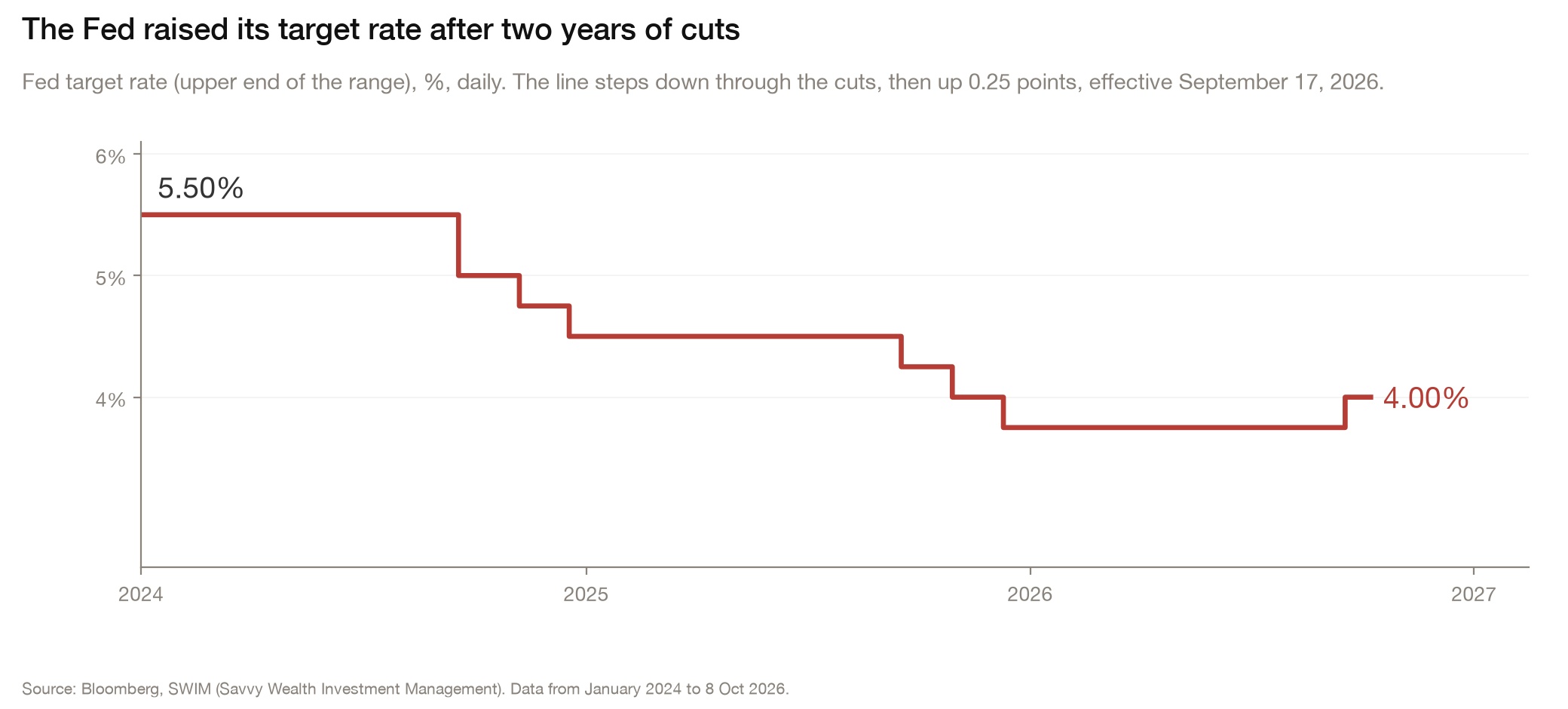
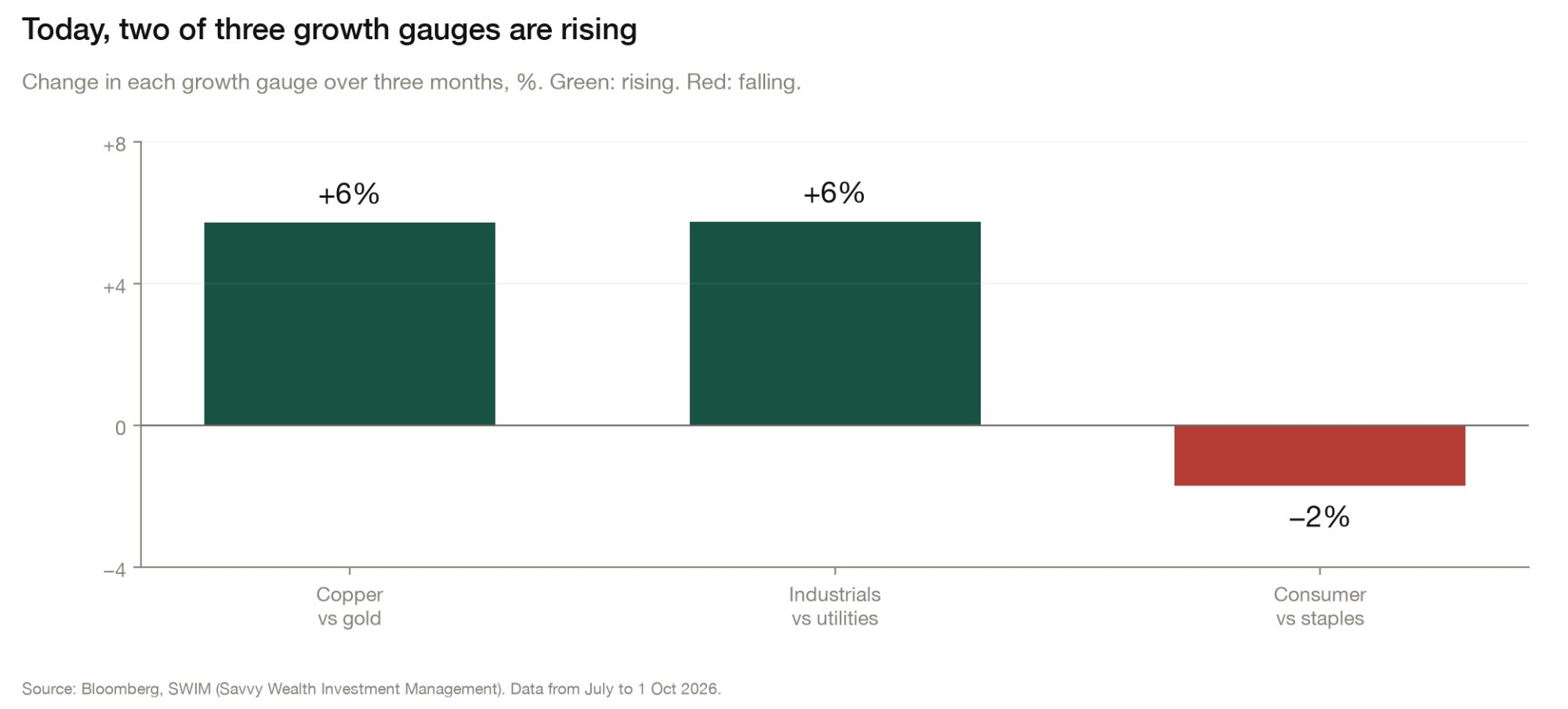
The Fed raised its target 0.25 points to 3.75–4.00%, effective September 17, 2026, after 1.75 points of cuts. Through October 2, 2026, the S&P 500 had not closed below its hike-day level. This is not a replay of 2022. That cycle started near zero and needed much larger hikes. This one starts after a run of cuts, with growth still rising. Copper against gold and industrials against utilities each rose about 6% over three months.
What would change our view
Our view would change if growth stalled while rates kept rising, or if credit tightened for real. Either would turn a bumpy patch into lasting damage.
How our portfolios are positioned
So the hike by itself is not a reason to sell, and not a reason to buy. Our portfolios already hold fewer bonds than a standard mix and do not reach for long-dated ones. They own stocks across the whole market rather than only its largest names. They hold some gold and a broad commodity basket as a hedge against inflation and against doubts about government finances. Another rate hike by itself would not change that. Our Q4 view, not a recommendation for any account.
Supporting resources
Client-ready deck: a plain-language slide deck of this piece, built for advisors to share with clients.
.blog-cta-btn{margin:1.5rem 0 2.5rem}.blog-cta-btn a.v2-button{display:inline-block;padding:1.4rem 2rem;border-radius:5px;background-color:var(--_v2-color-system---base-color-primary--gold);color:var(--_v2-color-system---base-color-primary--white);font-size:1.125rem;font-weight:500;line-height:100%;text-align:center;text-decoration:none}.blog-cta-btn a.v2-button:hover{background-color:#a09068;color:var(--_v2-color-system---base-color-primary--white);text-decoration:none}Download the client deck



Anshul Sharma is Chief Investment Officer at Savvy Wealth, where he oversees the firm’s investment strategy, portfolio design, and platform innovation. He partners across product, marketing, and operations teams to deliver portfolios that take a methodological approach to balance customization with scalability for advisors and their clients.

Ani Vedere is a Senior Research Analyst at Savvy with six years of experience across a macro hedge fund and a multi-asset RIA, where he built portfolio frameworks and investment systems. He translates macro research into implemented portfolios, advisor-facing tools, and automated workflows. He operates at the intersection of investing and product, with experience building systems that support portfolio construction, reporting, and client delivery.
Disclosures
Prepared for informational purposes only. Not investment advice or a recommendation to buy or sell any security. Past performance does not guarantee future results. Index returns are unmanaged, do not reflect fees or expenses, and are not available for direct investment. Data are from third-party sources believed to be reliable but not guaranteed. Figures are as of the dates shown and may be revised. Savvy Wealth Investment Management (SWIM) is a proprietary in-house solution of Savvy Advisors, Inc. Advisory services are provided by Savvy Advisors, a registered investment adviser.