



October 2026 Global Markets Recap

The earnings handoff: why the rest of the market rallied
Third-quarter results were strong. Through October 29, more than four in five of the 265 S&P 500 companies that had reported beat analysts' earnings estimates. Strong results alone did not lift the index. The stocks that weigh most in it were judged on something else: how much they are spending on AI, and how they pay for it.
That question hit the largest companies first. On October 21, Meta reported negative free cash flow for the quarter, which is the cash left after capital spending, and on October 26 it announced new common and convertible preferred shares to fund AI infrastructure. On October 29, Alphabet fell sharply after also reporting negative free cash flow and holding its 2026 capital spending plan at $195 billion to $205 billion. On October 30, Intel fell after guiding fourth-quarter revenue to $15 billion to $16 billion, below what analysts expected. Chip stocks took the brunt: the Philadelphia semiconductor index lost about a sixth of its value in the month.
Meanwhile, the earnings outlook for everyone else was improving. In mid-October, analysts' estimates for the fourth quarter had the other 493 companies in the S&P 500 growing their earnings about 4 percentage points faster than the seven largest. That would be the first quarter since 2022 in which the rest of the index out-grows the biggest companies. From early 2023 through the second quarter of 2026, the seven largest grew faster in every quarter, and third-quarter estimates already had the two groups growing at nearly the same pace.
October's market priced that handoff early. The equal-weight S&P 500 rose 5.00% while the cap-weighted index returned -0.87%, a gap of nearly 6 percentage points. Energy, staples, utilities, health care, financials and materials all rose, and the Russell 2000 of smaller companies gained 0.58%. Lower Treasury yields likely helped those groups, but they did not rescue the AI leaders, whose valuations rest on the spending question rather than on rates. Estimates can still change, and fourth-quarter results will show whether the handoff in earnings is real.
U.S. equities: AI leaders fell, and the average stock rose
The S&P 500 returned -0.87% in October, which hides a large split underneath. The Nasdaq Composite returned -5.28%, and Communication Services (-15.11%) and Information Technology (-6.80%) were the weakest sectors, weighed down by Meta, Alphabet and the chipmakers. Industrials barely moved (+0.30%). Everything else rose. Energy (+14.00%) led as oil climbed, followed by Consumer Staples (+11.62%), Utilities (+10.17%) and Health Care (+9.87%). Materials (+6.57%), Financials (+5.91%), Real Estate (+5.08%) and Consumer Discretionary (+3.93%) also gained. Smaller companies edged up, with the Russell 2000 at +0.58%. Investors grew more nervous as the month went on: the VIX, a gauge of expected stock swings, rose from about 16 to about 19.
- Indices: S&P 500 -0.87% · Nasdaq Composite -5.28% · Russell 2000 +0.58% · S&P 500 Equal-Weight +5.00%.
- Sector leaders: Energy +14.00%, Consumer Staples +11.62%, Utilities +10.17%, Health Care +9.87%, Materials +6.57%, Financials +5.91%.
- Sector laggards: Real Estate +5.08%, Consumer Discretionary +3.93%, Industrials +0.30%, Information Technology -6.80%, Communication Services -15.11%.
- Takeaway: The S&P 500 returned -0.87%, but the average stock, measured by the equal-weight index, rose 5.00%. The AI leaders pulled the index down, and nine of eleven sectors rose without them.

International markets: Asian chip markets fell, and most others rose
International equities fell in October, with most of the damage in Asia. Developed markets (MSCI EAFE) returned -0.72% and emerging markets (MSCI EM) -8.04%. The U.S. dollar rose 0.49%, which trims returns for U.S. investors who hold foreign stocks without a currency hedge. The euro slipped against the dollar and the yen was little changed. Central banks abroad held rates. The European Central Bank kept its deposit rate at 2.50% on October 29 and announced that President Christine Lagarde will step down on February 7, 2027. The Bank of Japan held on October 30.
Korea (-15.56%) and Taiwan (-8.37%), whose markets lean heavily on chipmakers, fell with U.S. AI stocks. China (-6.99%) fell for its own reasons: the CSI 300 index entered a bear market on October 22, down more than a fifth from its June peak, CNBC reported. Japan returned -4.17%. Elsewhere, markets rose. Mexico (+4.61%), Canada (+3.84%) and Australia (+3.64%) led, and India (+1.23%) and Germany (+0.91%) also gained.
- Up: Mexico +4.61%, Canada +3.84%, Australia +3.64%, India +1.23%, Germany +0.91%.
- Down: Japan -4.17%, China -6.99%, Taiwan -8.37%, Korea -15.56%.
- Broad benchmarks: MSCI EAFE -0.72%, MSCI EM -8.04%.
- Takeaway: Emerging markets returned -8.04%, but the damage was concentrated in Korea and Taiwan, the two markets most tied to AI chips, plus China. Five of the nine major markets we track rose, led by Mexico.

Fixed income: yields fell, led by inflation-adjusted yields
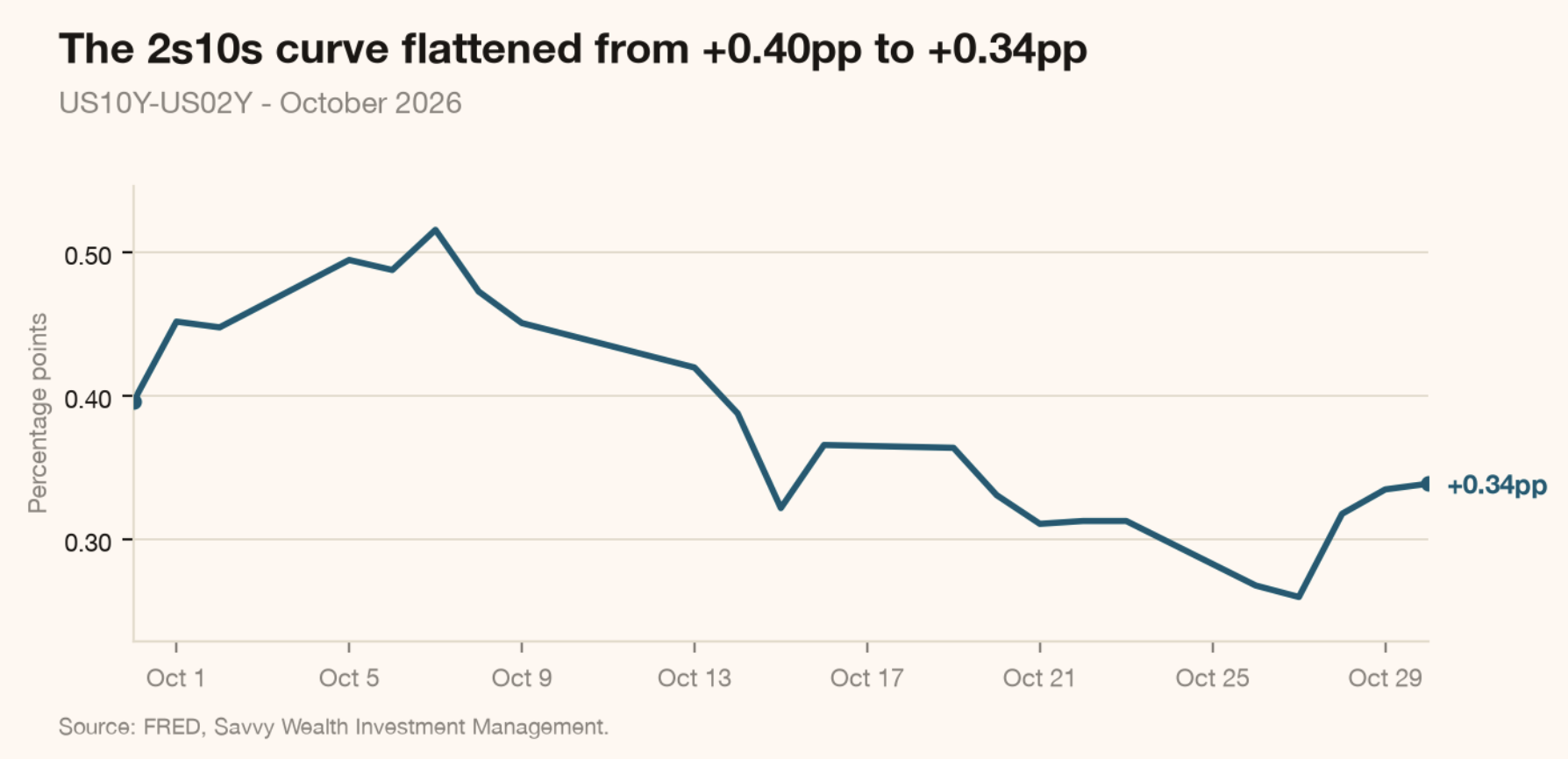
Bonds gained. The Bloomberg U.S. Aggregate returned 2.44% and the Global Aggregate 1.41%, a rebound after September losses. The 10-year Treasury yield fell from 5.29% to 4.93%, the 2-year yield fell 30 basis points and the 30-year 32 basis points. The gap between 10-year and 2-year yields narrowed to +0.34 percentage points (pp) from +0.40pp at the end of September. Almost all of the 10-year decline came from the inflation-adjusted (real) yield, while the market's expected inflation rate barely moved. So the decline reflected lower inflation-adjusted yields, not lower expected inflation.
The Fed held its policy rate at 3.75% to 4.00% on October 28, after raising it in September, with Lisa Cook and Beth Hammack dissenting in favor of another increase. Inflation stayed high. Consumer prices rose 3.7% from a year earlier in September. PCE inflation, the measure behind the Fed's 2% objective, was 3.6%, with core at 3.1%, the Bureau of Economic Analysis reported. By month-end, futures priced roughly 60 basis points of further increases over the next 12 months, down from about 90 at the end of September. Corporate credit moved the other way from Treasuries: high-yield spreads widened by 29 basis points and investment-grade spreads by 10.
- Bloomberg US Aggregate +2.44%, Global Aggregate +1.41%.
- The 10-year fell from 5.29% to 4.93% by October 30, and 2s10s narrowed to +0.34pp from +0.40pp.
- Takeaway: Treasury holders gained as yields fell, even with inflation well above the Fed's 2% objective and the Fed still leaning toward higher rates. Wider credit spreads show investors asking for more pay to lend to companies.

Commodities: oil jumped on Gulf attacks, and gold fell
Oil rose sharply. WTI gained 15.59% as tanker attacks near the Strait of Hormuz continued and the Houthis said they struck Saudi oil sites on October 29. WTI settled above $100 a barrel on October 30. Higher fuel prices feed straight into headline inflation, which is already well above the Fed's 2% objective. Gold returned -6.58% even as Treasury yields fell, and copper returned -1.15%. Bitcoin (IBIT) returned -8.41%, moving with the AI-linked stocks rather than as a haven. The U.S. dollar rose 0.49%.
- WTI crude +15.59%; S&P GSCI Copper -1.15%.
- Gold -6.58%; US Dollar +0.49%; Bitcoin (IBIT) -8.41%.
- Takeaway: Oil was the month's biggest mover and the main upside risk to inflation. Gold and bitcoin both fell, so neither acted as a hedge in October.

Key dates to watch in November 2026
Politics
- Nov 3: U.S. midterm elections.
Growth
- Nov 4: ISM Services PMI.
- Nov 6: Nonfarm Payrolls, Unemployment Rate.
- Nov 17: Retail Sales.
- Nov 25: Q3 GDP (second estimate).
Inflation
- Nov 10: CPI, Core CPI.
- Nov 25: PCE, Core PCE.
Earnings
- Late November: Nvidia quarterly results (expected Nov 17).
Fed
- Dec 9: FOMC rate decision (December 8 to 9 meeting).
The bottom line
A flat index hid a large rotation in October. Falling Treasury yields did not rescue the AI leaders, and the rest of the market did better: the S&P 500 returned -0.87%, the equal-weight index rose 5.00% and the Nasdaq returned -5.28%. Oil's 15.59% jump keeps inflation the main risk to lower rates. Two things decide whether the rotation lasts: whether fourth-quarter earnings confirm that the rest of the index is now growing faster than the largest companies, and whether credit spreads keep widening. A renewed rise in Treasury yields, or estimates for the other 493 being cut, would weaken the case.


Anshul Sharma is Chief Investment Officer at Savvy Wealth, where he oversees the firm’s investment strategy, portfolio design, and platform innovation. He partners across product, marketing, and operations teams to deliver portfolios that take a methodological approach to balance customization with scalability for advisors and their clients. Before joining Savvy, Anshul spent nearly two decades at Bank of America, where he managed the Chief Investment Office’s Sustainable Model Portfolio Suite, launched new proprietary offerings, and, as Head of Alternative Investment Strategy, provided guidance and thought leadership to advisors around hedge fund, private market, and real asset strategies. He began his career as an Investment Strategist at U.S. Trust, designing multi-asset portfolios for high-net-worth and institutional clients. Anshul holds a Master of Financial Engineering from UC Berkeley and a Bachelor of Computer Engineering from Lehigh University. Outside of work, he is an avid tennis player, enjoys time with his wife, two sons, and their Bernedoodle, and is an auto enthusiast who loves cooking and travel.

Ani Vedere is a Senior Research Analyst at Savvy Wealth, where he works across macro research, portfolio construction, and investment technology. He partners closely with the Chief Investment Officer and cross-functional teams spanning product, engineering, and design to develop scalable investment solutions, advisor-facing tools, and research workflows that help advisors deliver better outcomes for clients. Prior to joining Savvy, Ani was an Investment Analyst at a registered investment advisor, where he managed model portfolio implementation across hundreds of client accounts and built automated research and portfolio monitoring systems using Python and AI. Before that, he spent four years at a discretionary global macro hedge fund conducting multi-asset research, developing systematic investment frameworks, and building analytics to support portfolio management and trading decisions. Ani holds a Bachelor of Science in Finance from the University of Connecticut. Outside of work, he enjoys spending time outdoors, watching movies (in theatres!), reading, and writing. Fair warning: ask him about markets or macroeconomics, and you may end up in a much longer conversation than you planned.
Material prepared herein has been created for informational purposes only and should not be considered investment advice or a recommendation from the Savvy Investment Team. Information was obtained from sources believed to be reliable but was not verified for accuracy.
Savvy Wealth Investment Management (“SWIM”) is a proprietary, in-house investment solution offered by Savvy Advisors, Inc. (“Savvy Advisors”). It is designed to support financial advisors in the management of client portfolios. Savvy Wealth Investment Management is not a separate legal entity and is not independently registered as an investment adviser. All advisory services are provided by Savvy Advisors in its capacity as a registered investment adviser.


