

When Should You Hire a Dedicated Wealth Manager?

Knowing when to hire a financial advisor usually begins with a subtle feeling. You have built meaningful wealth, crossing $500,000 or even $1 million, but the spreadsheet or robo-advisor that got you there just won’t cut it now.
So, the question isn’t whether you need help. It’s “Have I outgrown what I have now?”
In this $500,000 to $1 million range, your investments, taxes, and estate decisions cease to be individual tasks. They become one interconnected problem. If you’re wondering, “Do I need a wealth manager?” it generally signifies that your financial life has outgrown general advice.
Key Takeaways
Here are a few key takeaways that we’ll cover throughout the rest of the article:
- Crossing $500,000 marks the threshold where your investments, taxes, and estate plans become a single, interconnected system that requires active coordination.
- General advisors focus primarily on portfolio allocations; dedicated wealth managers proactively sync your entire financial life, from asset growth to tax optimization.
- Self-managing wealth introduces an actual opportunity cost, including a documented 2% annual behavioral drag due to emotional or uncoordinated decisions.
- High-net-worth planning requires a strict fiduciary standard to ensure your advisor legally acts in your best interest at all times.
Financial Advisor vs. Dedicated Wealth Manager: Why the Difference Matters
Most people use the terms financial advisor and wealth manager interchangeably, but they actually represent two entirely different levels of service. Understanding the exact line between a wealth manager and a financial advisor is vital before deciding who should manage your money.
What a Financial Advisor Typically Does
A generalist financial advisor focuses primarily on investment allocation, building retirement projections, and conducting annual or semi-annual reviews. They may offer occasional, high-level tax guidance, but their approach is often reactive and one-dimensional.
This tier provides great value during earlier wealth stages. However, it sets a ceiling because they manage a portfolio rather than your entire financial life. For a comprehensive strategy, you’ll eventually need true high-net-worth financial planning.
What a Dedicated Wealth Manager Does Differently
If you ever wonder, “Should I hire a wealth manager?” look at the depth of coordination. A dedicated wealth manager offers proactive, multidisciplinary management in which your investment strategy, tax optimization, and estate planning work as a unified system. You get a single, dedicated advisor who knows your entire picture, rather than a rotating call center manager.
Most importantly, a manager acts under a strict fiduciary standard, meaning they are legally obligated to put your interests first. To learn more about these requirements, explore what it means to work with a true fiduciary financial advisor.
The Asset Threshold Where the Service Tier Changes
At $500,000 in investable assets, the intricacies of your financial picture usually justify moving to a wealth management firm. At this level, a typical 1% AUM fee equals $5,000 annually. A single coordinated tax strategy or wise estate decision routinely saves you far more than that fee.
When deciding how much money you should have before hiring a financial advisor or moving up a tier, consider the whole picture rather than just asset accumulation. At lower thresholds, such as $100,000, a one-time fee-only plan is generally the best option. However, at $500,000, continuous coordination is essential. If you’re wondering what your net worth should be when getting a financial advisor who manages it all for you, $500,000 is the clear inflection point.
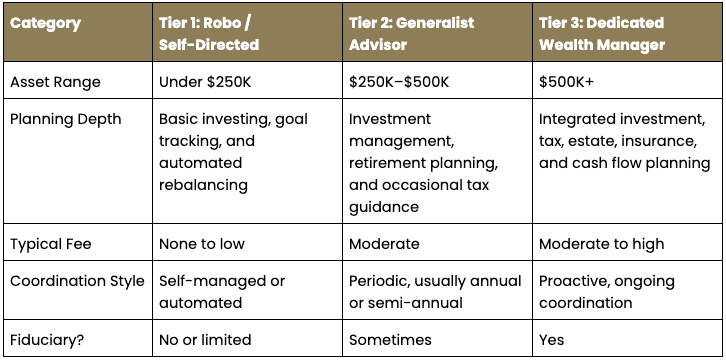
The $500K-$1M Inflection Point: When Complexity Outpaces Simplicity
The question at this stage isn’t whether you possess the dedication and know-how to manage your own money. Instead, you need to evaluate if the mounting cost of doing so (measured in lost time, mental bandwidth, and missed financial opportunities) has crossed a critical line.
The Coordination Problem
At lower wealth levels, your financial choices seldom collide. Once you cross $500,000, however, independent decisions disappear. A portfolio rebalance alters your tax bracket, an estate planning choice changes account ownership, and a retirement contribution impacts your current cash flow.
So, when is it time to hire a financial advisor? It’s when your decisions no longer optimize in isolation. For example, an unexpected Q4 RSU vesting can trigger the AMT, making a planned Roth conversion even more expensive if not coordinated.
What Self-Managing at This Level Actually Costs
We often view DIY investing as free, but managing a large amount of wealth on your own carries a heavy price tag. The comparison of hiring a financial advisor versus DIY investing ultimately comes down to measurable opportunity costs.
Industry data show that investors who self-manage without behavioral coaching lose an average of 2% per year to emotional decisions such as panic selling or improper rebalancing [1]. Furthermore, studies show individuals who partner with advisors hold an average of $132,000 in retirement savings compared to just $62,000 for those who do it themselves [2].

Four Signals You’ve Crossed the Threshold
You don't need to identify with every single financial roadblock to justify upgrading your coverage. Recognizing just one or two of these diagnostic signals is enough to warrant a serious conversation regarding your management strategy.
Your Equity Compensation is Getting Complex
As your career progresses, stock options and RSUs quickly complicate your tax situation. Managing vesting schedules, compensation risks, and 83(b) elections requires deep coordination so you don’t accidentally trigger a large tax bill.
For tech professionals and corporate executives, equity compensation is the most common trigger for crossing the $500,000 net worth threshold. Safely navigating this windfall requires following a clear financial order of operations for high earners to get the most out of every dollar.
A Major Wealth Event is on the Horizon
Major liquidity events require proactive planning long before any money changes hands. Whatever your situation (e.g., an upcoming business sale or an inheritance), financial milestones are easiest to plan for in advance. A generalist advisor brought in after the fact is simply cleaning up a tax mess. A wealth manager coordinates your strategy ahead of time and uses specialized estate planning tools to protect your legacy.
Your Tax, Investment, and Estate Decisions Aren’t Coordinated
Ask yourself, when was the last time your CPA, your investment advisor, and your estate attorney sat down together? In most self-managed scenarios, professionals work independently. Your accountant files taxes without looking at your portfolio’s cost basis, your advisor rebalances without verifying your marginal tax bracket, and your trust remains out-of-date since your net worth doubled. A wealth manager eliminates this issue by serving as a financial quarterback, implementing holistic tax-optimization strategies across all accounts.
You’re Making Time-Sensitive Decisions Without a System
Running your household finances yourself introduces immense key-person risks. If you’re too busy with your career to give your portfolio the attention it deserves, critical wealth deadlines will invariably slip through the cracks. Outsourcing to a wealth manager removes this particular point of failure. It replaces your ad-hoc, stress-inducing weekend spreadsheets with a resilient, automated financial system that continues protecting your family’s future even if you step away.
How to Choose a Dedicated Wealth Manager
Once you decide to upgrade your financial strategy, you need to vet potential partners carefully. Keep your evaluation tight, ask direct questions, and look for clear structural alignments so you can transition your wealth with complete assurance.
Start with Fiduciary Status
A strict fiduciary standard is entirely non-negotiable when hiring a firm. Fiduciaries are legally bound to act in your best interest at all times. In contrast, suitability-standard brokers only need to recommend products that are good enough, which is a gap that often leads to high-commission products.
Fee-only fiduciaries eliminate this potential conflicts of interest because they do not earn sales commissions. Before signing anything, check your advisor’s regulatory history using the SEC's Investment Adviser Public Disclosure (IAPD) (adviserinfo.sec.gov) or FINRA BrokerCheck (brokercheck.finra.org), and learn exactly what to look for when hiring a financial advisor to guarantee transparency.
Understand the Fee Structure Before You Commit
Firms generally use three primary pricing structures at the $500,000 threshold: AUM fees (usually 1% to 1.25%), flat annual retainers ($3,000 to $10,000), or a hybrid model. AUM models inherently match your advisor’s incentives with your account’s long-term growth, while flat retainers work well if you require intensive planning but less ongoing portfolio management.
A transparent advisor will proactively share their Form ADV with the SEC detailing these costs. Reviewing these structures lets you evaluate exactly how much a financial advisor costs relative to the value they provide.
Conclusion
Take an honest inventory of your current financials: are your tax, investment, and estate choices being made in harmony, or are they isolated from one another? Make sure to review the diagnostic signals outlined above. If two or more of these triggers hit close to home, upgrading to management is probably a good move. Also, protect your momentum by asking any prospective advisor for their formal Form ADV and securing their fiduciary commitment in writing.
Ready to see if your portfolio has crossed the threshold? Match with a Savvy fiduciary advisor today to build a coordinated, high-net-worth strategy tailored to your life.
Frequently Asked Questions
Is $500,000 enough to work with a financial advisor?
Yes. While some exclusive wealth managers require $1 million or more, $500,000 is the standard industry threshold where independent Registered Investment Advisors (RIAs) provide comprehensive, ongoing wealth management.
How much money should a person have before hiring a financial advisor?
For ongoing wealth management, $500,000 is the ideal entry point because your tax and investment needs justify the fee. If you have between $100,000 and $250,000, hiring a fee-only planner for a one-time financial plan is often more practical.
At what point is it worth getting a financial advisor?
It becomes worth it when your financial decisions no longer stand on their own. If an investment choice impacts your marginal tax bracket or an equity compensation event alters your estate plan, a professional quarterback is worth the cost.
What is the average fee for a financial advisor?
The industry average fee is about 1% of assets under management (AUM) annually for a $500,000 portfolio. This fee typically scales downward as your investable assets exceed the $1 million and $2 million thresholds.


Justin Ericksen, CFP®, CFA, AFC®, is an Advisor at Blue Barn Wealth, passionate about helping individuals and families build clarity and confidence around their finances. Justin combines comprehensive planning with disciplined investment strategy to support long-term success.

Sources
[1] Investors Missed the Best of 2024's Market Gains, Latest DALBAR Investor Behavior Report Finds
Material prepared herein has been created for informational purposes only and should not be considered investment advice or a recommendation. Information was obtained from sources believed to be reliable but was not verified for accuracy. All advisory services are offered through Savvy Advisors, Inc. (Savvy Advisors), an investment advisor registered with the Securities and Exchange Commission (SEC).
.webp)

.webp)
